The generation of innovative ideas is a cornerstone of creative disciplines, particularly game design. This process is often perceived as difficult, a challenge succinctly captured by the perspective of Linus Pauling1, who famously stated,
"The best way to have a good idea is to have a lot of ideas and throw out all the bad ones."
This principle underscores that creativity is not necessarily about a single moment of inspiration but rather a prolific and iterative process of generation and refinement. Game design, in particular, relies on developing layers of ideas that continuously evolve and enhance an original concept, making structured brainstorming techniques indispensable.
Noun-Verb-Adjective
One effective method for breaking down a conceptual theme into tangible game elements is the Noun-Verb-Adjective exercise. This technique facilitates the deconstruction of a real-world system or abstract idea to explore its potential representation within a game. By systematically identifying the core components of a topic, designers can build a foundational vocabulary for their game world.
Example
When conceptualizing a game to promote healthy eating habits for children, participants would brainstorm and list all associated nouns (e.g., ‘apple’, ‘candy’, ‘stomach’, ‘energy’), verbs (e.g., ‘eat’, ‘run’, ‘digest’, ‘grow’), and adjectives (e.g., ‘healthy’, ‘sugary’, ‘strong’, ‘tired’).
Upon completion, this exercise provides a clear inventory of potential game objects (nouns), player actions and system mechanics (verbs), and the desired qualities or emotional tones (adjectives) that will define the user experience.
Gamestorming
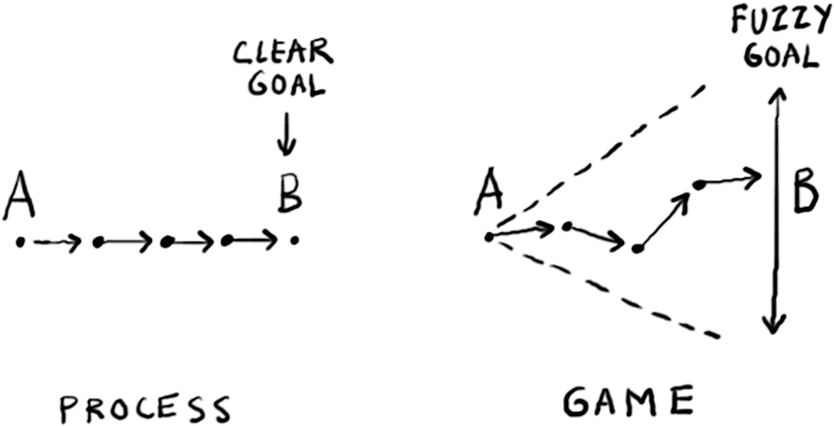
The Noun-Verb-Adjective exercise is an example of a broader methodology known as Gamestorming, a term popularized by Dave Gray, Sunni Brown, and James Macanufo. This framework champions the use of game-like structures to navigate complex problem-solving and innovation. A central tenet of Gamestorming is the distinction between a ‘process’ and a ‘game’ in achieving goals.
Definition
- A process is characterized by a linear, direct path from a starting point '
' to a well-defined, ‘clear goal’ at point ' '. This approach is suitable for problems where the solution and the steps to reach it are already known. - In contrast, creative endeavors like game design operate within a ‘game’ framework. Here, the path from '
' to ' ' is non-linear and exploratory, meandering through a cone of possibilities toward a ‘fuzzy goal’. This ‘fuzzy goal’ represents an objective that is not yet clearly defined, requiring exploration to be fully understood.
Characteristics of Fuzzy Goal Exploration
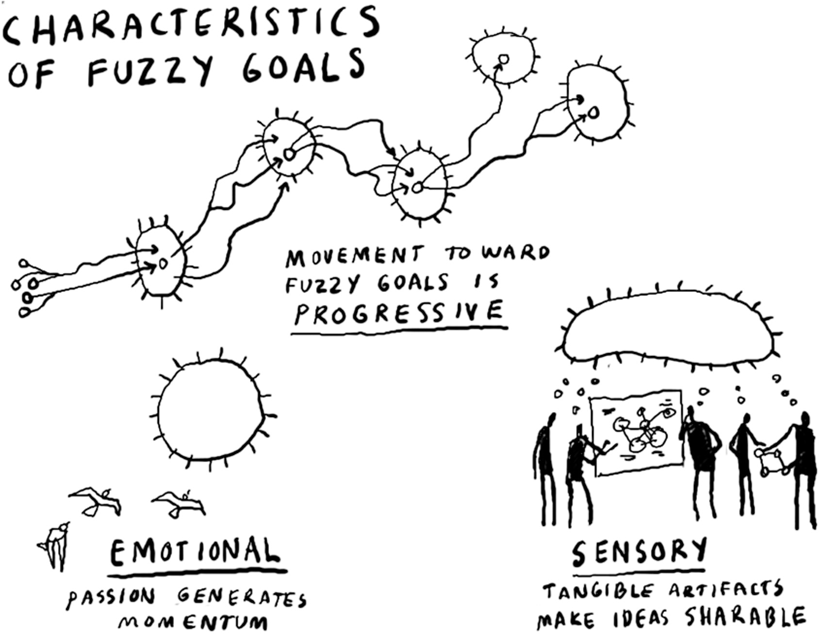
Navigating the ambiguous space of a ‘fuzzy goal’ has several distinct characteristics.
- First, the journey is inherently progressive; movement is not a single leap but a series of iterative steps where each discovery informs the next. This creates a winding path of continuous learning and adaptation.
- Second, this exploration is driven by an emotional component. In the absence of a clear, predetermined path, it is passion and intrinsic motivation that generate the momentum required to persist through uncertainty and explore novel territories.
- Finally, the process relies heavily on the creation of sensory, tangible artifacts. Abstract ideas are made concrete and sharable through physical representations such as sketches on a whiteboard, notes, or early prototypes. These tangible artifacts transform individual thoughts into collective objects that a team can discuss, manipulate, and build upon, fostering a shared understanding and facilitating collaborative innovation.
The Three-Act Structure of Gamestorming
The Gamestorming methodology is structured around a three-act process that guides a team from an initial state of inquiry to a final, actionable outcome. This structure is often visualized as a diamond, representing a fundamental cycle of divergence followed by convergence.
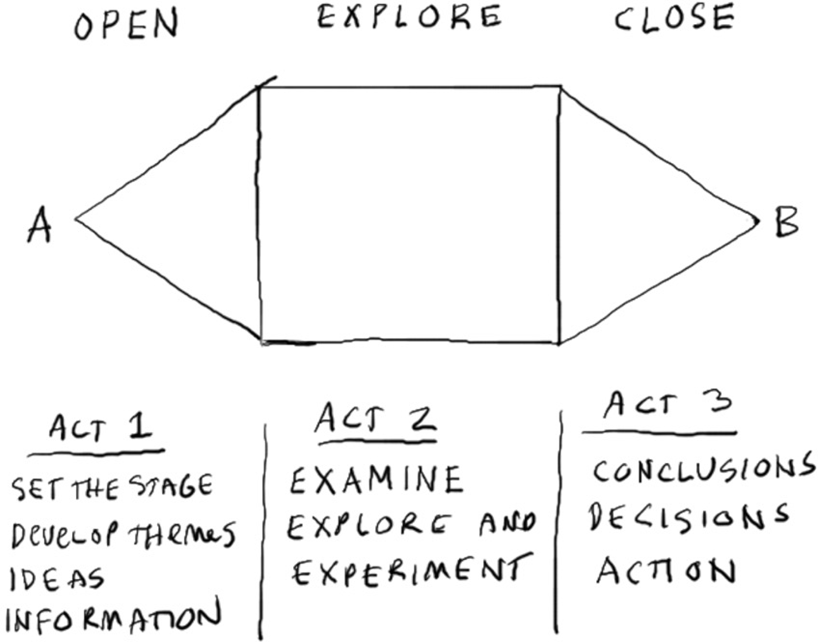
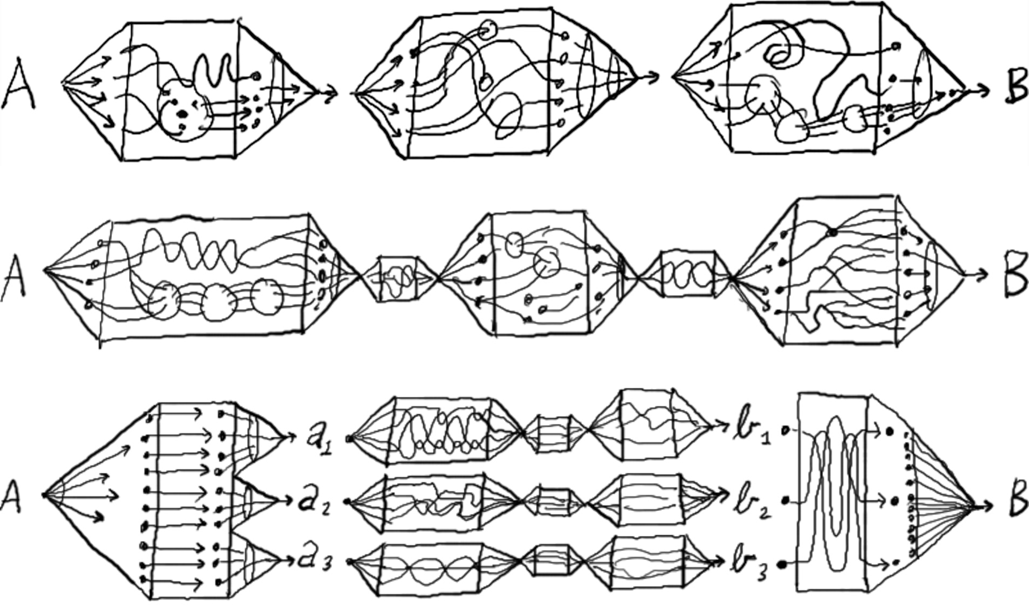
This process is not a rigid formula but a flexible framework that can be adapted to various creative challenges, accommodating iterative loops, parallel explorations, and even chaotic, tangled paths of discovery as needed. The core rhythm, however, remains consistent across its three distinct phases: Opening, Exploring, and Closing.
Opening Phase
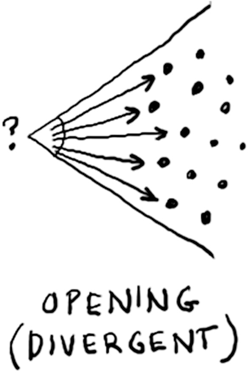
The first act, Opening, is a phase of deliberate divergence. Its primary objective is to expand the problem space and generate the widest possible range of ideas, information, and perspectives. During this stage, judgment is suspended to encourage an uninhibited flow of thought, allowing all participants to contribute their knowledge and initial concepts. The success of this phase is measured by its breadth; the more raw material generated, the richer the foundation will be for the subsequent stages. This is visually represented by an inquiry expanding from a single point into a broad and scattered cloud of possibilities.
Exploring Phase
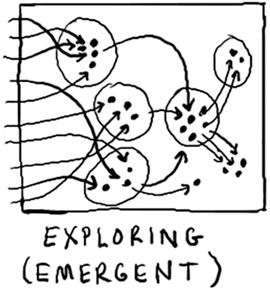
Following the expansive Opening is the second act, Exploring, which is an emergent phase focused on sense-making. With a multitude of ideas collected, the team’s focus shifts to analysis and synthesis. Participants examine the generated concepts, looking for patterns, analogies, and novel connections. This involves sifting, sorting, and experimenting with the ideas, often clustering them to see how they relate to one another. The goal of the Exploring phase is not to make decisions but to create the conditions for unexpected insights and surprising combinations to emerge from the initial chaos of the divergent stage.
Closing Phase
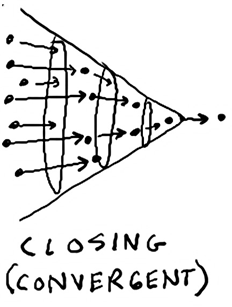
The final act, Closing, is a convergent phase dedicated to evaluation and decision-making. Having explored the landscape of possibilities, the team must now narrow its focus and move toward concrete conclusions. Ideas are assessed with a more critical and realistic perspective to determine which are the most promising and where energy and resources should be invested. This phase is about making choices, prioritizing concepts, and defining the actionable next steps that will carry the project forward. The process funnels the broad set of explored ideas down to a single, focused path of execution.
The Essentials of a Gamestorming Session
To facilitate this three-act structure, Gamestorming employs a set of core components and techniques. The fundamental rhythm of the process is managed through Opening and Closing, which act like a form of breathing for the session—expanding to generate possibilities and contracting to create focus. Two critical rules govern this rhythm: one should not attempt to open and close simultaneously, and every divergent phase (an opening) must eventually be resolved with a convergent one (a closing). The process is initiated by a Fire Starter, typically a well-crafted question or a fill-in-the-blank phrase designed to ignite discussion and idea generation.
The ideas themselves are captured on Artifacts, such as sticky notes or index cards, which serve as tangible carriers of meaning. The generation of these artifacts, or nodes, is a primary activity of the Opening phase, often accomplished through methods like the “post-up,” where participants write ideas silently and then share them with the group. These artifacts are then organized within a Meaningful Space, such as a whiteboard or wall, where they can be collectively viewed, manipulated, and clustered to reveal emergent patterns. Visual thinking is further encouraged through Sketching and Model Making, which help clarify and communicate complex ideas.
To overcome cognitive biases and stimulate novel thinking, techniques such as Randomness, Reversal, and Reframing are used to shuffle and recombine ideas in new contexts. The collaborative spirit is maintained through Improvisation, embodying the “Yes, and…” principle to build upon rather than dismiss others’ contributions. As the session moves toward convergence, Selection becomes critical. Techniques like Dot Voting or Forced Ranking provide structured methods for a group to prioritize the most promising ideas from a large set. Finally, the entire methodology is underpinned by a willingness to Try Something New, ensuring the creative process itself remains fresh and effective.
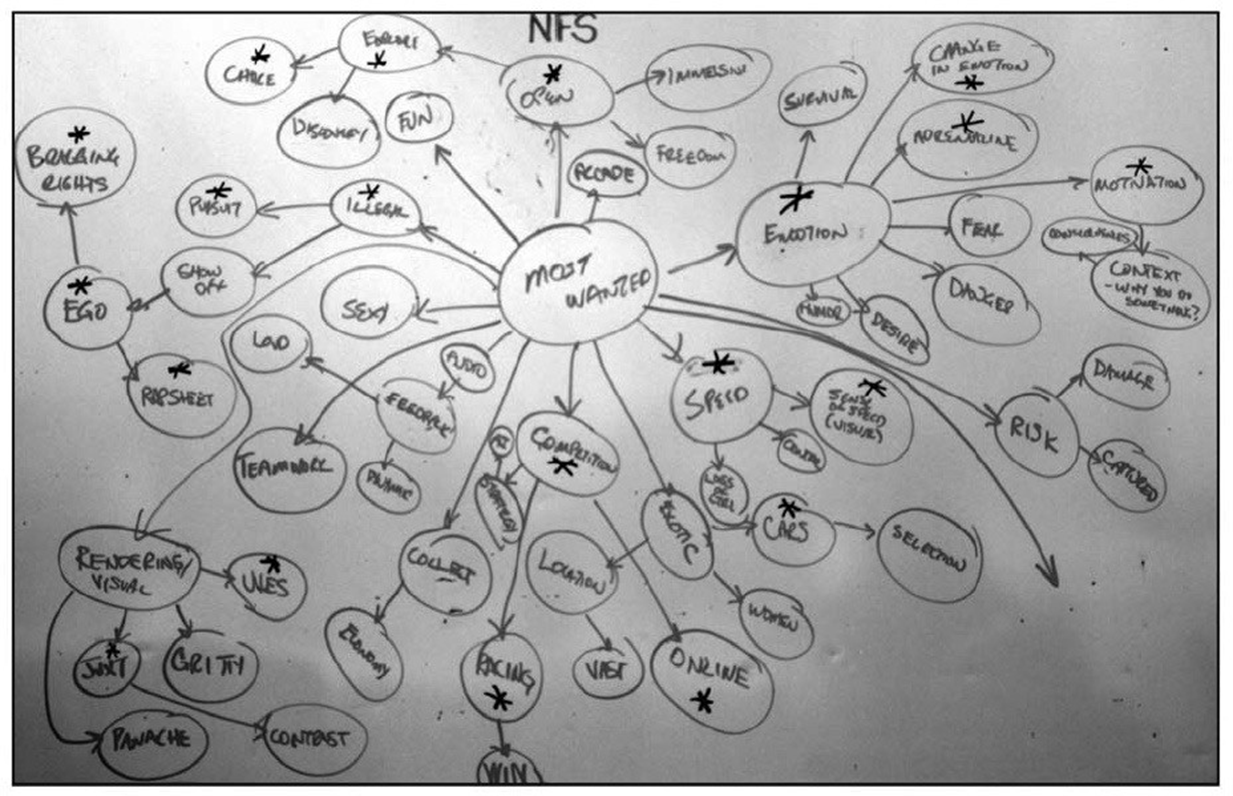
Practical applications of these principles are evident in artifacts from real-world brainstorming sessions.
Example
For example, a mind map for a concept like “Need for Speed” demonstrates the Opening and Exploring phases, where central themes of emotion, speed, and risk are deconstructed into a network of associated ideas.
Similarly, a session using a multitude of sticky notes illustrates Node Generation within a Meaningful Space, where concepts such as vision, perception, and cause are clustered and sorted to synthesize a deeper understanding of a game’s core principles.
Footnotes
-
Linus Pauling is the only person to have won both the Nobel Prize in Chemistry and the Nobel Peace Prize as an individual. ↩