1 - What Is Computer Ethics
Summary
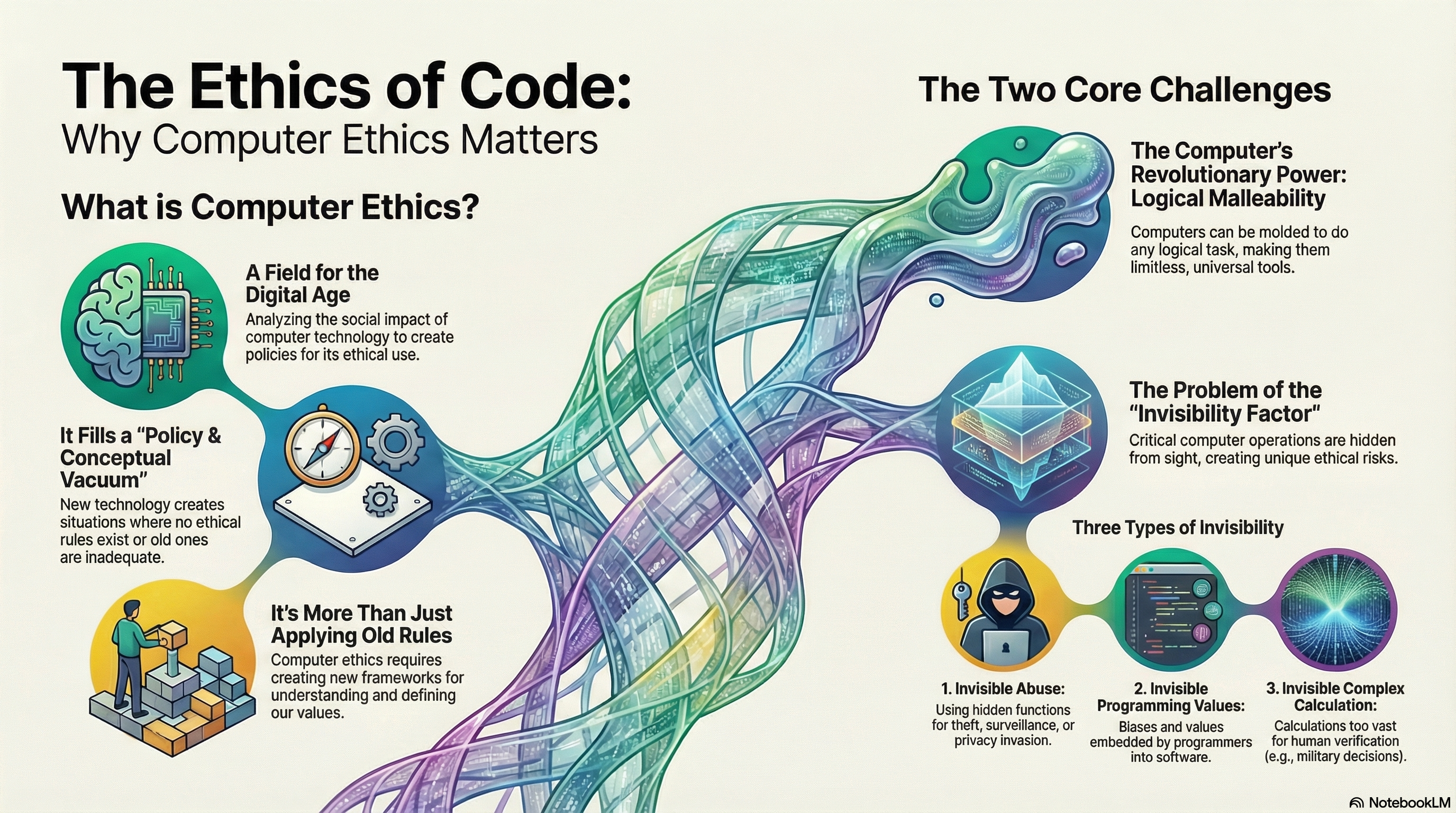
This document synthesizes the core arguments from James H. Moor’s essay, “What Is Computer Ethics?“. The central thesis is that computer ethics is a distinct, dynamic, and critically important field of study, not merely the application of traditional ethics to a new technology. Moor defines computer ethics as “the analysis of the nature and social impact of computer technology and the corresponding formulation and justification of policies for the ethical use of such technology.” The field’s necessity arises from the “policy and conceptual vacuums” created by the novel capabilities of computers. Addressing these vacuums requires deep conceptual analysis to understand a problem before ethical policies can be formulated.
The essay identifies two primary arguments for the significance of computer ethics.
First, computers are revolutionary not because of their speed or cost, but because of their “logical malleability.” This core feature allows them to be configured to perform any task that can be described by inputs, outputs, and logical operations, making the computer a near-universal tool. This malleability is driving a two-stage “Computer Revolution,” analogous to the Industrial Revolution, that is moving from a stage of introduction to one of permeation.
In this second stage, computer technology is not just a tool but is fundamentally transforming the nature of societal institutions and activities like elections, work, finance, and education.
Second, the “invisibility factor” of computing creates unique ethical vulnerabilities. Moor outlines three types of invisibility:
- invisible abuse (the intentional use of hidden operations for unethical acts),
- invisible programming values (values embedded, often implicitly, into software), and
- invisible complex calculation (computations so vast they are beyond human inspection).
These hidden aspects create a dilemma where the efficiency of invisibility is offset by significant vulnerability, necessitating the development of ethical policies to guide when and how we should trust computer systems.
Defining Computer Ethics
According to James H. Moor, computer ethics is a field of study that examines the social impact of computer technology to formulate and justify policies for its ethical use. This scope is broad, encompassing hardware, software, and the networks that connect them. The field addresses both personal and social policies.
The Role of Policy and Conceptual Vacuums
A central task of computer ethics is to address situations where existing policies for ethical conduct are non-existent or inadequate. These are termed policy vacuums.
- Cause: Computers provide new capabilities and choices for action, creating scenarios that previous ethical and legal frameworks did not anticipate.
- Function of Computer Ethics: To determine what should be done in these cases by formulating and justifying new policies to guide actions.
Often preceding a policy vacuum is a conceptual vacuum, where a fundamental lack of clarity about the nature of the situation prevents the formulation of coherent policy.
- Nature of the Problem: A problem may seem clear initially, but reflection reveals a “conceptual muddle.” Much of the work in computer ethics is devoted to creating coherent conceptual frameworks.
- Illustrative Example (Software Protection): The task of formulating a policy to protect computer programs reveals numerous conceptual questions:
- What is a computer program?
- Is it intellectual property that can be owned, like a patentable process, or is it an idea that cannot be owned?
- Is it an expression of an idea, protectable by copyright?
- Is a machine-readable program a copy of a human-readable one?
Answering these questions requires a clear conceptualization of what a program is, which in turn shapes the facts and the subsequent policy.
Relationship to General Ethics and Science
Computer ethics is not a standalone discipline that ignores established fields. It is positioned between science and ethics and relies heavily on both.
- General Ethics: Provides the foundational categories and procedures for determining ethical relevance, such as concepts of “good,” basic rights, and impartiality. These are essential for comparing and justifying policies.
- Science: Provides crucial factual information. Moor notes that “ethical disputes turn not on disagreements about values but on disagreements about facts” with surprising frequency.
Computer ethics is thus a complex field analyzing the relationships between facts, conceptualizations, policies, and values in the context of constantly evolving technology.
The Revolutionary Nature of Computer Technology
The essay argues that the widespread impact of computers constitutes a genuine revolution, comparable to the Industrial Revolution. The source of this revolution is a unique, intrinsic feature of the computer itself.
The defining characteristic that makes computers revolutionary is their logical malleability.
- Definition: Computers can be shaped and molded to perform any activity that can be characterized in terms of inputs, outputs, and connecting logical operations.
- Significance: Just as the steam engine provided the raw power for the Industrial Revolution, the logic of a computer is the raw resource of the Computer Revolution. Because logic is universally applicable, the potential applications of computer technology are virtually limitless. The computer is described as “the nearest thing we have to a universal tool.”
- Contrast with Other Views: This concept is contrasted with the narrower view of computers as mere “number crunchers.” While computers can be described mathematically, this is just one of many possible interpretations. Reifying the mathematical notation as the computer’s essence is a mistake that can lead to flawed judgments about its appropriate use.
The enabling conditions for this revolution—such as affordability, speed, and size—are important but secondary to the fundamental nature of logical malleability.
The Two-Stage Model of the Computer Revolution
Drawing a parallel with the Industrial Revolution, Moor proposes a two-stage development model for the Computer Revolution.
- Stage One: The Technological Introduction Stage (approx. 1945-1985): This stage involved the creation, testing, and refinement of electronic computers. The technology was applied to limited segments of the economy and was understood as a tool for performing standard jobs more efficiently.
- Stage Two: The Technological Permeation Stage (present and future): In this stage, computer technology becomes deeply integrated into the core of social institutions and human activities, fundamentally transforming their nature and purpose.
The transition from Stage One to Stage Two is marked by a shift in the kinds of questions being asked.
| Area of Activity | Stage One Question (“How well does a computer do X?“) | Stage Two Question (“What is the nature and value of X?“) |
|---|---|---|
| Elections | ”How efficiently do computers count votes in a fair election?" | "What is a fair election?” (When networks use computers to project winners before polls close, the technology not only counts votes but also influences them, transforming the electoral process.) |
| Work | ”How well do computers help us work?” (e.g., by calculating payrolls) | “What is the nature of this work?” (When executives work from home and robots perform factory labor, traditional concepts of the workplace, job definition, and sources of professional pride are reexamined.) |
| Finance | ”How well do computers count money?" | "What is money?” (In a cashless society with electronic fund transfers, the question arises whether money has disappeared in favor of computer records, or if electronic impulses have themselves become money.) |
| Education | ”How well do computers educate?" | "What is education?” (As computers take over routine instruction and facilitate indirect information exchange, the values of traditional education, such as the necessity of human contact for learning, are challenged.) |
This transformative effect creates the policy and conceptual vacuums that make computer ethics a field of substantial practical importance.
The Invisibility Factor: A Source of Ethical Vulnerability
A second, independent argument for the importance of computer ethics is the invisibility factor. Most computer operations are hidden from the user, which is a source of both efficiency and vulnerability. This invisibility manifests in three distinct ways, each with ethical significance.
1. Invisible Abuse
This is the intentional use of a computer’s invisible operations to engage in unethical conduct. The technology’s involvement is essential, and policies are needed for detection and prevention.
- Theft: A programmer instructs a bank’s computer to deposit fractions-of-a-cent rounding errors from interest calculations into a personal account. This theft is difficult to notice without sophisticated accounting programs or access to the code.
- Invasion of Privacy and Property: Individuals or groups (like the “414s”) use home computers and phone lines to surreptitiously access and alter confidential information in remote systems, including hospitals, banks, and government labs.
- Surveillance: Computers can monitor employee work terminals, electronic mail, and phone calls discreetly and continuously, or be used to tap data transmission lines, giving one party a covert advantage over another.
2. Invisible Programming Values
This refers to the values that become embedded in a computer program, often implicitly, as a programmer makes decisions to translate abstract specifications into concrete code.
- Biased Software: The “SABRE” airline reservation system, promoted by American Airlines, was programmed with a bias that favored its own flights, even when they were not the best available option. This embedded value had significant financial consequences for competing airlines.
- Unforeseen Limitations: The computer simulator used to train operators at the Three Mile Island nuclear power plant was not programmed to handle simultaneous, independent malfunctions. When such a scenario occurred in reality, the operators were unprepared, contributing to the disaster. The programming decision, however unconscious, embedded a specific, and ultimately flawed, assumption about reality into the system.
3. Invisible Complex Calculation
This is the most disturbing form of invisibility, where computers perform calculations that are too enormous and complex for humans to inspect and verify.
- The Four-Color Conjecture: This mathematical proof was completed in 1976 after more than a thousand hours of computer time, during which computers analyzed thousands of cases. While the general structure of the proof is known, the full set of calculations is practically impossible for a human to check.
- High-Stakes Decision-Making: The ethical issue becomes acute when such calculations are used for decisions with major consequences, such as the military’s use of computers to assess threats and decide on launching nuclear weapons. The fallibility of computers must be weighed against the potential for even greater human error without their aid.
This invisibility factor presents a dilemma: we rely on invisible operations for efficiency, but this reliance makes us vulnerable. Formulating policies to manage this trade-off is a core challenge for computer ethics.
2 - The Ethics of HRI and Traditional Moral Theories
Summary
This document synthesizes an analysis of the applicability of traditional moral theories—such as utilitarianism, Kantianism, and virtue ethics—to the emerging field of human-robot interaction (HRI). The central argument is that these classical ethical frameworks are fundamentally ill-suited for HRI because they were developed exclusively with human-human interaction in mind, long before the advent of robotics and artificial intelligence.
The analysis hinges on the distinction between moral agents (those who can act rightly or wrongly) and moral patients (those who can be acted upon rightly or wrongly). The proliferation of robots challenges these categories, raising two primary questions: how should robots behave around humans, and how should humans behave around robots?
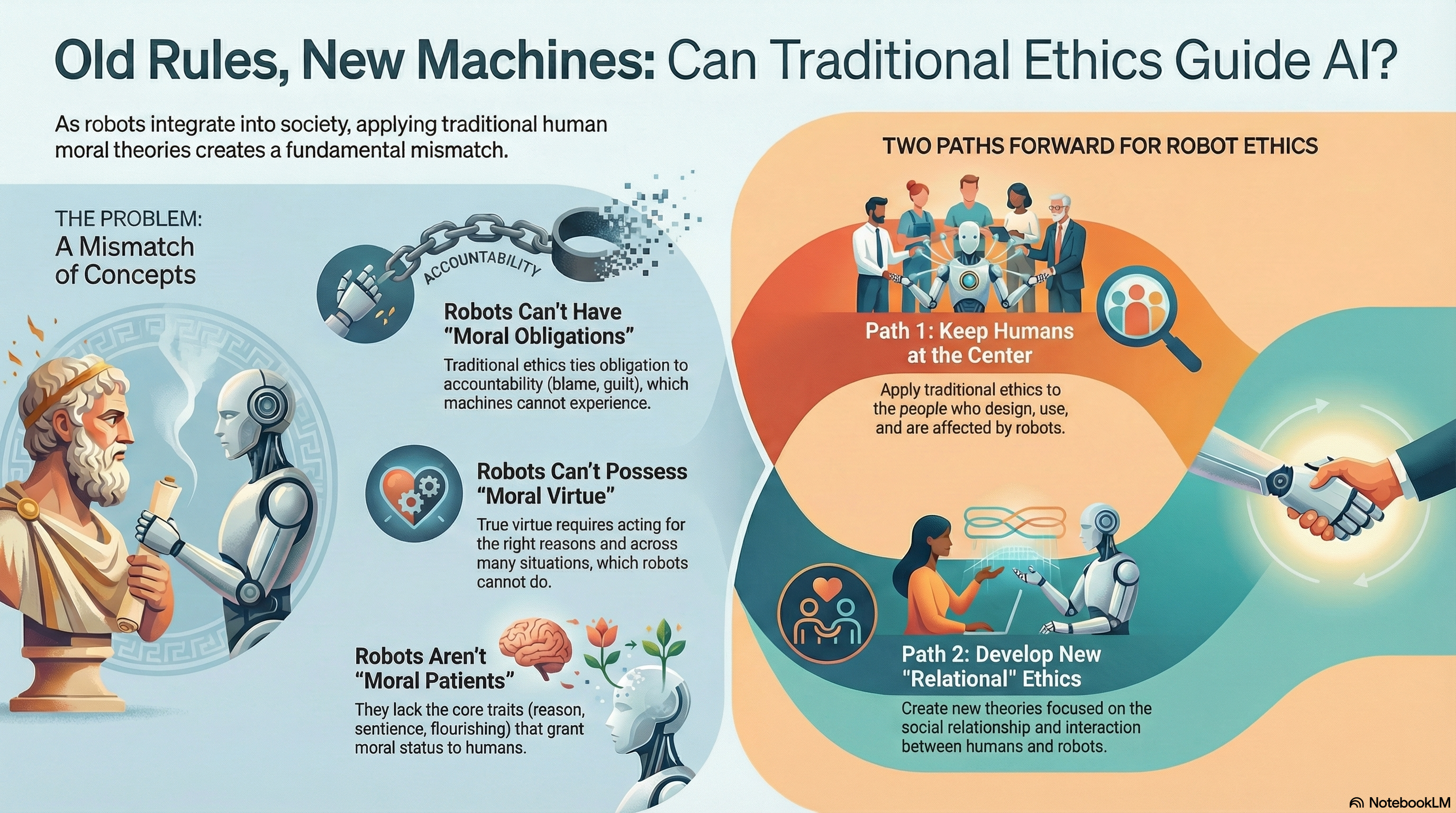
Traditional theories prove incompatible with the concept of robots as either moral agents or patients for several key reasons:
- Moral Obligation: Moral agency is linked to concepts like duty, blame, punishment, and a guilty conscience. Since robots cannot experience these, they cannot have “obligations” in the traditional sense, rendering the idea of an obligated robotic agent incoherent.
- Moral Virtue: Virtue, as conceived by Aristotle, is a “robustly demanding” ideal requiring a stable disposition to act for the right reasons across diverse situations—a capacity current AI lacks. A more minimalist Humean concept of virtue as “usefulness” is possible but is considered a watered-down, non-moral equivalent.
- Moral Patiency: The basis for being a moral patient in traditional ethics rests on capacities robots do not possess: the ability to flourish (eudaimonia in virtue ethics), the possession of practical reason and a will (sapiens in Kantianism), or the capacity for pleasure and pain (sentience in utilitarianism).
Two primary paths forward are identified.
- The first is to apply traditional theories by maintaining a strictly human-centric focus, where the programmers, designers, and users of robots are the only relevant moral agents, and the impact of HRI on humans (or animals) is the only relevant moral consideration.
- The second path, advocated by thinkers like David Gunkel and Mark Coeckelbergh, is to “think otherwise” by developing new, non-traditional “relational” ethical theories that focus on the social interactions between humans and robots rather than on their intrinsic properties.
The analysis concludes by proposing a hybrid approach: use traditional theories when focusing on the human dimension of HRI, but develop new theories to conceptualize robots if and when they are considered as a novel class of moral agents and patients.
A “Robot Invasion” and New Ethical Questions
The increasing integration of robots and artificial intelligence into diverse areas of human life—including self-driving cars, military autonomous systems, logistics, domestic appliances, and even intimate companionship—has been described as a “robot invasion.” This proliferation raises novel and urgent ethical questions that fall into two main categories:
- Robot Behavior: How should robots and other intelligent machines be designed and programmed to behave around human beings?
- Human Conduct: How should human beings conduct themselves around robots and other machines with advanced AI?
The branch of digital ethics that confronts these two questions is defined as the ethics of human-robot interaction.
Moral Agents and Moral Patients
To analyze the ethics of HRI, it is essential to distinguish between two key roles in any moral scenario:
- Moral Agent: An entity capable of acting rightly or wrongly and who can be held responsible for their conduct.
- Moral Patient: An entity against whom one can act rightly or wrongly.
The case of Boston Dynamics’ four-legged robot, “Spot,” illustrates this distinction. When engineers were shown kicking the robot to demonstrate its stability, many viewers reacted negatively, with comments like “Kicking a dog, even a robot dog, just seems wrong.” In this scenario, the engineers are viewed as the moral agents, while the robot is cast in the role of a moral patient.
Conversely, in discussions about self-driving cars or autonomous weapons, the machines themselves are often framed as potential moral agents who must make life-and-death decisions, with humans being the moral patients.
Four Perspectives on the Moral Status of Robots
The potential roles of robots as agents and patients can be categorized into four primary viewpoints:
| Viewpoint | Description | Proponents / Examples |
|---|---|---|
| 1. Robots as Both Agents and Patients | Robots and other machines can be considered both moral agents and moral patients, in addition to humans. | e.g., David Gunkel, John-Stewart Gordon |
| 2. Robots as Agents Only | Robots can be a form of moral agent (perhaps less advanced than humans) but cannot and | |
| 3. Robots as Patients Only | Robots can be moral patients if they behave like entities we already view as patients (e.g., animals), but they cannot be responsible moral agents fit for punishment. | A potential interpretation of John Danaher’s work |
| 4. Humans as the Only True Agents and Patients | Only human beings (and some non-human animals) can be moral agents and patients. When we discuss robot ethics, the relevant agents are always human (designers, users), and the real patients are always humans who may be negatively impacted. | e.g., Joanna Bryson, Aimee Van Wynsberghe |
Applying Pre-Modern Theories to Modern Technology
A primary challenge in HRI ethics is the temptation to apply traditional moral theories like utilitarianism, Kantianism, and virtue ethics directly. This approach is problematic for two main reasons:
- Historical Mismatch: These theories were developed centuries before the existence of AI and robots, with human-human interaction as their exclusive focus. They are not inherently designed for human-technology interaction.
- Decontextualization: Applying these theories to AI often involves truncating them into simple, programmable principles (e.g., “Maximize happiness, minimize suffering!”). This decontextualization strips away the “comprehensive theories of human nature, rationality, the human condition, moral psychology, etc.” that underpin and motivate the original frameworks.
Robots as Moral Agents
Traditional moral theories presuppose certain capacities for moral agency that robots do not possess, making a direct application unworkable.
Moral Obligation
The concept of moral agency is deeply tied to moral obligation or duty. A moral agent is one who is under an obligation to act in certain ways. John Stuart Mill provided a canonical statement on this connection:
“We do not call anything wrong, unless we mean to imply that a person ought to be punished in some way or other for doing it; if not by law, by the opinion of his fellow-creatures; if not by opinion, by the reproaches of his own conscience… Duty is a thing which may be exacted from a person, as one exacts a debt.”
— John Stuart Mill, Utilitarianism (2001: 48-49)
This raises critical questions for robotic agents:
- Could a self-driving car be sensibly punished or blamed for its actions?
- Could a robot suffer from a “guilty conscience”?
Since the answer to these questions is no, a robot cannot have duties or obligations in the traditional sense. A machine programmed to follow moral rules would be a “moral agent without any obligations,” a concept that is nonsensical from the perspective of traditional ethical theory.
Moral Virtue
Another avenue for agency is through the possession of moral virtues. However, robots fail to meet the standards for virtue established by major traditional theories.
- Hume’s Theory of Virtue: Hume defined virtue as a personal characteristic that is useful or agreeable to oneself or others. While a robot like a Roomba can be useful and thus have a “virtue” in a “minimalistic and watered-down sense,” this is a difference in kind, not degree, from human virtues like justice or compassion.
- Aristotle’s Theory of Virtue: Aristotle’s ideal is “robustly demanding.” It requires a disposition to do the right thing, at the right time, for the right reasons. This involves:
- Acting for Reasons: This requires mental states that robots lack.
- Robustness: A virtuous disposition must be stable across a wide range of challenging circumstances, whereas AI is typically task-specific and operates in controlled environments.
- Unity of the Virtues: Possessing one virtue (e.g., courage) correctly requires possessing others (e.g., wisdom, justice), a holistic integration that is unrealistic for a machine.
Robots as Moral Patients
When examining what qualifies an entity for moral consideration as a patient, traditional theories again point to properties that are exclusively human (or at least biological).
| Ethical Theory | Basis for Moral Patiency | Applicability to Robots |
|---|---|---|
| Virtue Ethics | The capacity for eudaimonia (human flourishing). | Robots cannot “flourish” in this sense. |
| Kantian Ethics | The possession of practical reason and a will (sapiens). | Robots lack a will and practical reason. |
| Utilitarianism | The capacity for sensibility to pleasure and pain (sentience). | Robots are not sentient and do not feel pleasure or pain. |
Because robots lack these foundational properties, traditional moral theories seemingly imply that robots cannot be moral patients for the same reasons that humans are. Authors like Romy Eskens argue that because sex robots lack sapiens and sentience, they cannot be raped, as they do not have the moral status that would make nonconsensual sex a violation.
Two Proposed Paths for HRI Ethics
Given the incompatibility of traditional frameworks, two distinct approaches for developing a coherent ethics of HRI are proposed.
Path A: Maintain a Human-Centric Focus with Traditional Theories
This approach argues that we can continue to use traditional moral theories by insisting that human beings are the only relevant moral agents and patients.
- When Programming Robots: The moral agent is not the self-driving car but the human programmer, designer, or policymaker. It is their decisions that should be guided by principles of utilitarianism, deontology, or virtue ethics.
- When Humans Interact with Robots: If there is a reason not to kick a robot dog, it is not out of consideration for the robot. Rather, the real moral patients are other humans who might be offended, or the human agent themselves, who may develop a cruel or vicious character by engaging in such acts. This mirrors Kant’s argument that cruelty to animals makes one crueler towards humans.
Path B: “Think Otherwise” with New Relational Theories
This alternative, advanced by thinkers like David Gunkel and Mark Coeckelbergh, suggests that if we are to take the idea of robots as agents and patients seriously, we need to move beyond traditional theories and “think otherwise.”
This involves a “relational turn” in ethics. Instead of focusing on the intrinsic properties and capacities of isolated entities (like sentience or reason), a relational approach focuses on the interactions and relationships that form between humans and robots. Moral status would arise from a robot’s “social presence” and its ability to evoke social responses in humans.
A Hybrid Framework
A synthesized path forward suggests a dual approach that leverages the strengths of both traditional and new ethical frameworks.
- For Human-Centric Concerns: We can and should continue to use traditional moral theories when analyzing the ethics of HRI from the perspective of humans as the sole moral agents and patients.
- For Robot-Centric Concerns: If and when we begin to seriously consider robots as a new class of moral agents and patients, we will need to develop new, non-traditional ethical theories, perhaps along the relational lines suggested by Gunkel and Coeckelbergh.
This dual framework does not violate the principle of moral universality, which demands that we “treat like cases alike.” Since humans and robots are fundamentally not “like cases,” treating them differently—both in practice and in theory—is consistent with this principle. The old moral agents and patients can be understood through the theories developed for them, while new potential agents and patients may require new theories altogether.
3 - Ethics, Technology And Engineering
Summary
This document provides a comprehensive synthesis of normative ethics, outlining four primary theoretical frameworks and their application to moral issues in engineering. The analysis is grounded in the foundational distinction between descriptive judgments (what is) and normative judgments (what ought to be). It examines ethical theories not as rigid manuals but as frameworks for reasoned moral decision-making.
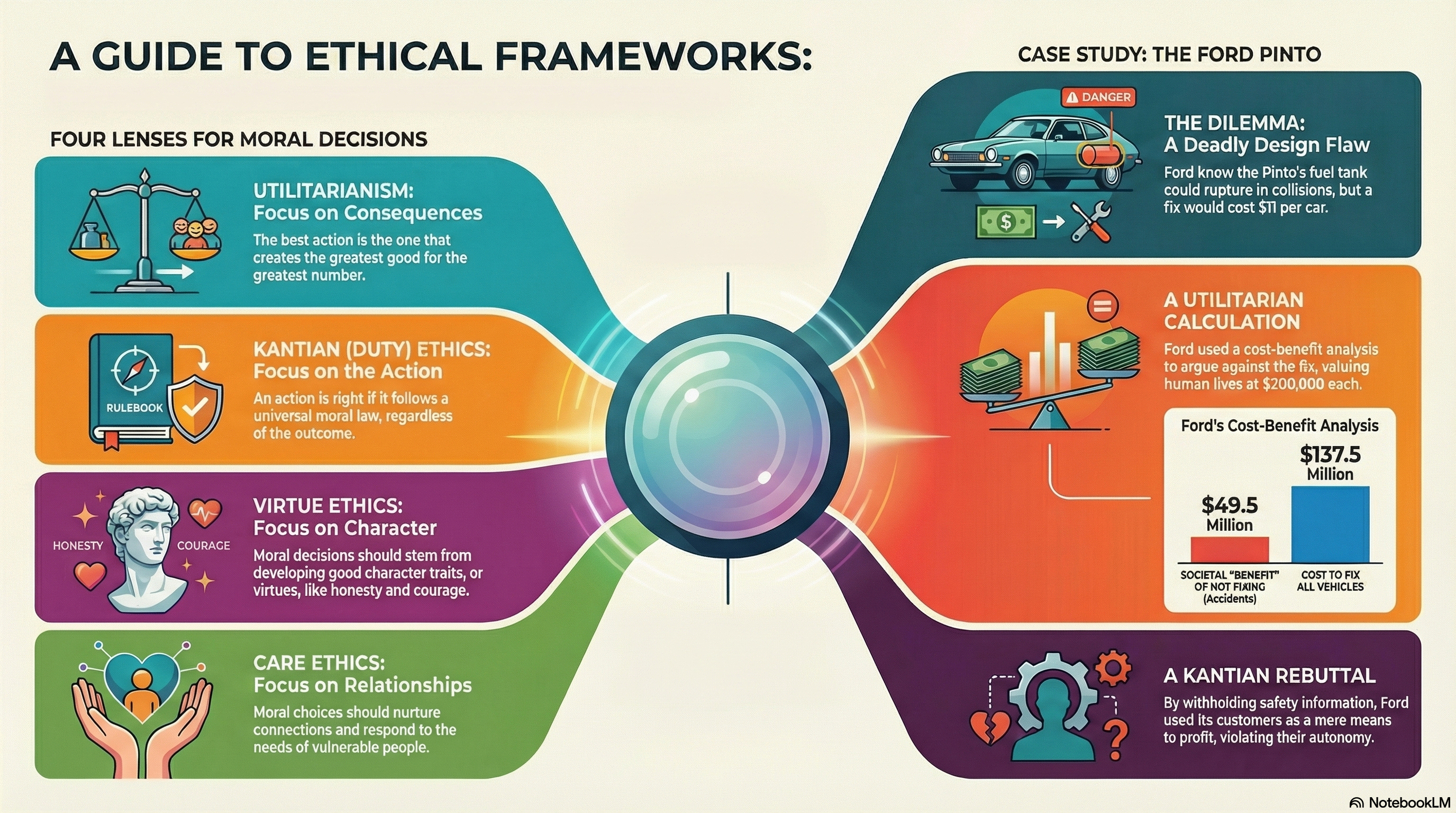
The central themes are organized around four dominant ethical theories:
Utilitarianism:
A form of consequentialism that judges the morality of an action based on its outcome. The core tenet, the “utility principle,” advocates for choosing the action that produces the greatest happiness for the greatest number of people. While intuitively appealing, it faces significant criticism regarding the measurement of happiness, the potential for exploitation of minorities, the neglect of personal relationships, and the justification of immoral acts for a greater good. The Ford Pinto case, with its controversial cost-benefit analysis valuing human life at $200,000, serves as a stark example of act utilitarianism in practice.
Kantian Theory:
A deontological (duty-based) framework developed by Immanuel Kant. It posits that the morality of an action is inherent in the action itself, not its consequences. Actions must conform to universal moral laws derived from reason. This is encapsulated in the Categorical Imperative, which has two key formulations:
- the Universality Principle (act only on maxims you could will to be universal laws) and
- the Reciprocity Principle (treat humanity always as an end, never merely as a means).
Its primary weaknesses are its rigidity and its inability to resolve conflicts between duties.
Virtue Ethics:
Originating with Aristotle, this theory shifts the focus from actions or consequences to the character of the moral agent. It asks what qualities or virtues a good person should develop to achieve eudaimonia (the good life). Virtues are seen as a “golden mean” between two extremes (e.g., courage is the mean between cowardice and recklessness). For engineering, this translates into cultivating professional virtues such as objectivity, creativity, cooperation, and having an eye for detail, as exemplified by William LeMessurier’s handling of the Citicorp Center design flaw.
Care Ethics:
A more recent theory that emphasizes the importance of relationships, context, and compassion over abstract principles. It holds that moral development arises from understanding specific situations and the vulnerability of others. In an engineering context, this framework highlights the special responsibilities engineers and companies have to stakeholders (consumers, employees, the public) due to their interconnectedness and often asymmetrical relationships.
The document concludes that while no single theory provides a universally accepted answer, these frameworks are indispensable tools for identifying ethical dimensions, structuring moral arguments, and avoiding simplistic or unjustified decision-making in complex professional situations.
Foundations of Ethical Judgment
The source text establishes a clear distinction between morality and ethics:
- Morality: Defined as “the whole of opinions, decisions, and actions with which people, individually or collectively, express what they think is good or right.” It represents the existing norms and values within a society or group.
- Ethics: Defined as “the systematic reflection on what is moral.” It is a critical, rational process of searching for a justifiable basis for morality, rather than simply accepting existing customs.
Ethics can be studied from two perspectives:
- Descriptive Ethics: Describes existing morality, including customs, habits, and opinions, without passing judgment.
- Normative Ethics: Judges morality and formulates recommendations on how people should act. It is prescriptive and seeks to establish a framework for what is right and wrong.
A core distinction is made between two types of statements:
- Descriptive Judgment: A statement about what is, was, or will be the case. These judgments are either true or false. For example, “the Challenger met all safety standards of the time.”
- Normative Judgment: A value judgment about whether something is good or bad, desirable or undesirable, right or wrong. These judgments refer to how the world should be. For example, “the Challenger should never have been launched.”
Values, Norms, and Virtues
Ethical theories are built upon three fundamental concepts:
- Values: Lasting convictions about what is worth striving for to achieve a good life or a just society (e.g., freedom, justice, health).
- Intrinsic Value: Something valuable in and of itself (e.g., happiness).
- Instrumental Value: Something valuable as a means to an intrinsic value (e.g., money used to help the poor).
- Norms: Rules that prescribe required, permitted, or forbidden actions. They are concrete means to realize abstract values. For example, the value of “safety” is translated into traffic norms like “give way to drivers from the right.”
- Virtues: Desirable human characteristics or qualities that constitute a person’s character and enable them to be a good person. Examples include honesty, courage, and integrity. Virtues are expressed in action and are developed through practice.
| Differentiator | Values | Norms |
|---|---|---|
| Nature | Ends | Means |
| Scope | Global, abstract | Specific, concrete |
| Function | Goals to be achieved | Rules to limit action |
| Dependency | Hard to achieve without norms | Ineffective without underlying values |
Extreme Approaches: Relativism and Absolutism
Two extreme ethical positions are identified and critiqued:
- Normative Relativism: Argues that all moral points of view are equally valid and relative to the individual or culture. It asserts there are no universal norms.
- Criticisms: It contains an inherent contradiction (positing the universal norm that all opinions must be respected), makes meaningful moral discussion impossible, and can lead to unworkable or intolerable situations (e.g., tolerating torture).
- Absolutism: A rigid form of universalism which holds that a system of norms and values is universally applicable to everyone, without exception.
- Criticisms: It fails to account for situations where breaking a rule is the most responsible action (e.g., killing in self-defense), offers no guidance for conflicting norms (e.g., whistleblowing), and allows no room for independent moral judgment.
Core Ethical Theories
The source text analyzes four major ethical theories, which approach moral judgment from different perspectives: the consequences, the action itself, the actor’s character, or the relationships involved.
| Theory | Focus | Point of Departure | Guiding Question |
|---|---|---|---|
| Utilitarianism | Consequences | Values | Which action produces the best overall outcome? |
| Deontology (Kantian Theory) | Action | Norms | Does this action conform to a universal moral duty? |
| Virtue Ethics | Actor | Virtues | What would a virtuous person do? |
| Care Ethics | Relationships | Care / Empathy | How can I best maintain relationships and care for the vulnerable? |
Utilitarianism (Consequentialism)
Developed by Jeremy Bentham and refined by John Stuart Mill, utilitarianism judges an action by its consequences, specifically its ability to produce pleasure and minimize pain.
Core Principles:
- Utility Principle: An action is morally right if it results in the “greatest happiness for the greatest number.”
- Hedonism: The belief that pleasure is the only intrinsic good.
- Moral Balance Sheet: Bentham proposed a “hedonistic calculus” to quantitatively measure the pleasure and pain resulting from an action, considering factors like intensity, duration, and certainty. Modern cost-benefit analysis is a variant of this.
Refinements by John Stuart Mill:
- Qualitative Pleasures: Mill argued that some pleasures (e.g., intellectual) are qualitatively superior to others (e.g., physical). He famously stated, “It is better to be a human being dissatisfied than a pig satisfied; better to be Socrates dissatisfied than a fool satisfied.”
- Freedom Principle (No Harm Principle): Everyone is free to pursue their own pleasure as long as they do not harm or hinder the pleasure of others. This was intended to protect individual rights from being sacrificed for the majority’s happiness.
Criticisms of Utilitarianism:
- Measurement Problem: Happiness and pleasure are subjective and difficult to measure or compare between individuals.
- Unpredictable Consequences: The future consequences of an action are often unknown or uncertain.
- Problem of Distributive Justice: The theory can justify an unjust distribution of benefits and burdens, potentially leading to the exploitation of minorities if it serves the greater good.
- Ignores Personal Relationships: It treats all individuals as anonymous units, ignoring special moral obligations to friends, family, or colleagues.
- “End Justifies the Means”: It can permit actions that are intrinsically wrong (e.g., lying, breaking promises) if they lead to a positive outcome.
Variants:
- Act Utilitarianism: The traditional form, which judges each individual act by its consequences.
- Rule Utilitarianism: Judges actions by whether they conform to a rule that, if generally followed, would maximize utility. This addresses the “end justifies the means” problem by upholding rules like “do not falsify data” because the rule itself promotes overall happiness.
Kantian Theory (Deontology)
Immanuel Kant’s duty-based ethics holds that the morality of an action is determined by its conformity to a universal moral law, regardless of the consequences.
Core Principles:
- Good Will: The only thing that is unconditionally good is a “good will”—acting from a sense of duty and respect for the moral law.
- Autonomy: Rational humans have the capacity to set moral laws for themselves and are duty-bound to obey them.
- Categorical Imperative: The supreme principle of morality from which all duties can be derived. Kant offered two primary formulations:
- The Universality Principle: “Act only on that maxim which you can at the same time will that it should become a universal law.” This tests whether a personal rule of action could be adopted by everyone without creating a logical contradiction. For example, a universal law of breaking promises would render the very institution of promising meaningless.
- The Reciprocity Principle: “Act as to treat humanity, whether in your own person or in that of any other, in every case as an end, never as means only.” This principle forbids using people as mere instruments to achieve one’s own goals and demands respect for their rational agency.
Criticisms of Kantian Theory:
- Conflicting Norms: The theory provides no clear way to resolve situations where duties conflict (e.g., a duty to tell the truth conflicts with a duty to protect a friend). William David Ross’s concept of prima facie norms (norms that are applicable unless overruled by a more important norm in a specific situation) is offered as a potential solution.
- Rigidity: A strict adherence to universal rules can lead to morally problematic outcomes by ignoring the negative consequences of an action. The case of boycotting products made with child labor, which might drive those children into worse situations like slavery, illustrates this tension.
Virtue Ethics
Based on the philosophy of Aristotle, virtue ethics centers on the character of the moral agent rather than on rules or consequences.
Core Principles:
- The Good Life (Eudaimonia): The ultimate goal of human action is to achieve a state of flourishing or “the good life” by realizing one’s uniquely human potential through reason and virtuous activity.
- Virtue as a Mean: A moral virtue is a stable character trait that represents a middle course between two extremes of vice (excess and deficiency). For example, courage is the mean between recklessness and cowardice.
- Development of Virtue: Virtues are not innate but are developed through practice and habituation—“we become just by doing just acts.”
- Practical Wisdom (Phronesis): The intellectual virtue that enables one to identify the correct mean in any given situation and make the right choice for action.
Virtues for Morally Responsible Engineers: The source lists several virtues specific to engineering practice:
- Expertise/professionalism
- Clear and informative communication
- Cooperation
- Willingness to make compromises
- Objectivity
- Being open to criticism
- Stamina
- Creativity
- Striving for quality
- Having an eye for detail
- Careful reporting
Criticisms of Virtue Ethics:
- Not Action-Guiding: It does not provide concrete rules or a clear calculus for how to act in a specific moral dilemma.
- Virtues Are Not Unconditionally Good: As Kant argued, virtues like self-control and moderation can make a person with malicious intent (a “cold psychopath”) even more dangerous.
Care Ethics
Care ethics shifts the focus from abstract principles to the importance of relationships, vulnerability, and specific contexts.
Core Principles:
- Importance of Relationships: Moral problems are understood in terms of the responsibilities that arise from our connections with others. The goal is to maintain and repair these relationships.
- Context over Principles: Moral development comes from encountering concrete situations and learning to respond with empathy and care, rather than by applying general rules.
- Vulnerability and Dependence: It pays special attention to asymmetrical relationships (e.g., employer-employee, engineer-public) and the responsibility of the more powerful party to care for the more vulnerable one.
Criticisms of Care Ethics:
- Vagueness: The concept of “care” is not clearly defined, making the theory philosophically vague and not strongly normative. It doesn’t specify what transforms “care” into “good care.”
- Not Action-Guiding: Like virtue ethics, it focuses more on attitude and motivation than on providing clear guidance for solving moral problems.
Application of Theories in Engineering
The Ford Pinto Case
On August 10, 1978, a Ford Pinto was rear-ended, causing its fuel tank to rupture and explode, killing three teenagers. This case became a landmark in applied ethics.
Factual Background:
- In the late 1960s, Ford rushed the Pinto’s development to compete with smaller imported cars, cutting the typical development time from 43 to 24 months.
- Styling took precedence over engineering, leading to the placement of the fuel tank behind the rear axle.
- Internal crash tests showed the tank could be punctured in collisions as slow as 35 km/h.
- Ford knew of simple fixes, costing around $11 per vehicle, to make the tank safer.
- The design met government safety standards at the time, so Ford proceeded with production without alterations.
Ford’s Utilitarian Cost-Benefit Analysis: To justify its decision, Ford conducted an analysis that weighed the cost of a recall against the societal benefit of preventing deaths and injuries.
Benefits of Not Fixing the Cars (Savings from Accidents Prevented by an $11 Fix):
| Component | Unit Cost (US$) | Total (US$) |
|---|---|---|
| 180 burn deaths | 200,000 | 36,000,000 |
| 180 serious burn injuries | 67,000 | 12,060,000 |
| 2,100 burned vehicles | 700 | 1,470,000 |
| Total | 49,530,000 |
Costs of Fixing the Cars (Recall):
| Component | Unit Cost (US$) | Total (US$) |
|---|---|---|
| 11 million cars | 11 per car | 121,000,000 |
| 1.5 million light trucks | 11 per truck | 16,500,000 |
| Total | 137,500,000 |
Conclusion: The analysis concluded that recalling the vehicles would cost society $87.47 million more than the benefit of the lives saved and injuries prevented.
Analysis of the Ford Pinto Case Through Different Ethical Lenses:
- Act Utilitarianism: Ford’s cost-benefit analysis is a direct application of this theory. However, it is criticized for the arbitrary monetary value placed on human life and the unreliability of its estimates.
- Rule Utilitarianism: This perspective would likely condemn Ford’s actions. It would argue that a general rule like “companies must produce safe cars” promotes the greatest happiness in the long run, even if violating it seems beneficial in a single case.
- Kantian Theory:
- Universality Principle: The maxim “market unsafe cars without informing consumers” cannot be universalized, as it would destroy the trust necessary for a car market to function.
- Reciprocity Principle: By not informing consumers of the risks, Ford treated them as a mere means to its goal of increasing sales, violating their rational autonomy.
- Care Ethics: Ford had a relationship with its consumers, who were vulnerable and dependent on the company’s information. Ford failed in its responsibility to care for them by not disclosing the safety risks.
The LeMessurier Case
William LeMessurier’s actions regarding his design of the Citicorp Center in New York illustrate engineering virtues in practice.
Factual Background:
- LeMessurier’s innovative design used pillars placed at the midpoint of each side.
- During construction, contractors used bolts instead of the specified welds to connect supports, weakening the structure.
- A student’s query prompted LeMessurier to re-examine his calculations, leading him to discover that the building was vulnerable to collapse in a 16-year storm.
- LeMessurier immediately informed all relevant parties (Citicorp, insurers, city officials) and proposed a solution. The building was successfully retrofitted.
Virtuous Conduct: LeMessurier is praised not just for doing his duty, but for demonstrating key virtues:
- Courage: He risked his reputation and career by admitting a major design flaw.
- Responsibility: He proposed a solution and saw it through, taking ownership of the problem.
- Openness to Criticism: He took the student’s concerns seriously, which led to the discovery of the flaw.
- Dedication to Public Safety: His actions prioritized the safety of the public above all else.
Social Ethics of Engineering
Drawing from care ethics, this approach focuses on the social arrangements and group processes in engineering rather than just individual decisions. It proposes procedural norms for engagement to ensure decisions are acceptable, even if individuals are unhappy with the outcome. Proposed norms include:
- Competency
- Democratic information flows and teams
- Service-orientation
- Diversity
- Cooperativeness
4 - Virtues in the Digital Age
Summary
This document synthesizes an analysis of the growing relevance of virtue ethics as a framework for navigating the moral complexities of the digital age. Early approaches to digital ethics were dominated by consequentialist and deontological theories, but these have proven limited in addressing the novel, rapidly evolving, and deeply transformative nature of digital technologies.
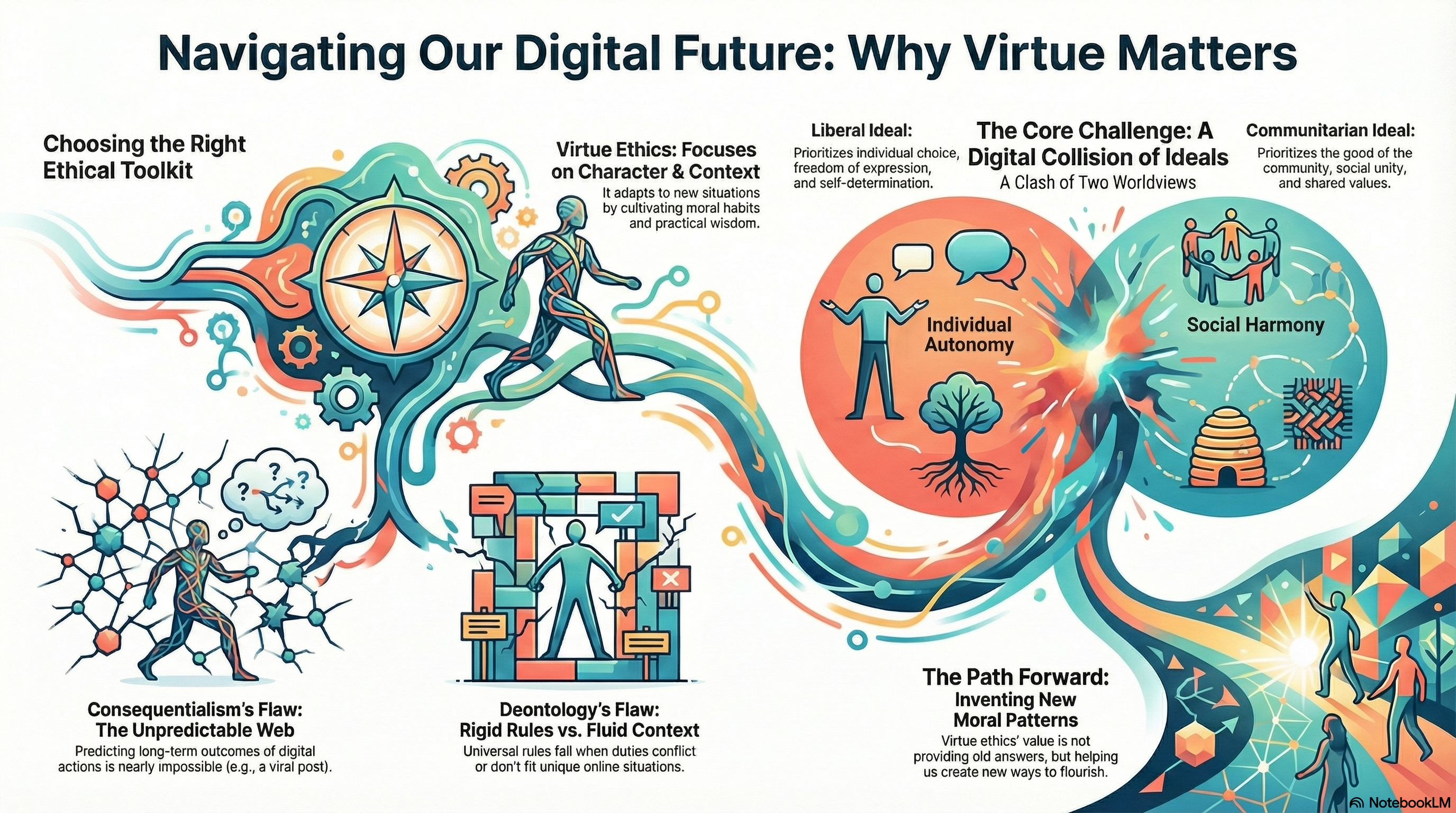
Virtue ethics offers a more robust framework by focusing on how digital practices shape moral character and by providing the contextual sensitivity needed for an uncertain technological landscape. It holds distinct advantages over consequentialism, which struggles to calculate the unpredictable outcomes of digital actions, and deontology, whose rigid, universal rules are often insensitive to the specific moral textures of online interactions.
Despite its advantages, virtue ethics is not without limitations. It has been criticized for being parochial, relativistic, and overly focused on individual character rather than collective moral action—a significant shortcoming in an era of global, interconnected challenges. The most pressing challenge for a virtue-based digital ethic is the collision of two competing global norms: a liberal ideal centered on individual autonomy and a communitarian ideal focused on social harmony.
Novel technological developments, particularly the rise of sophisticated artificial agents, expose the inadequacies of both the liberal and communitarian frames. Neither can satisfactorily address the moral status of non-human agents deeply integrated into our social lives. This impasse, however, reveals the ultimate value of virtue ethics. It does not provide ready-made answers from the past but instead equips us with the moral practices and virtues—especially courage, humility, and moral imagination—necessary to invent entirely new patterns of human flourishing suited to our unprecedented technological future. The central task is to move beyond worn-out dichotomies and collaboratively construct a new path toward a just and sustainable digital society.
The Ascendancy of Virtue Ethics in Digital Contexts
The study of digital ethics has seen a notable shift from its early reliance on consequentialist and deontological theories towards virtue ethics. This approach is distinguished by its focus not on discrete acts or outcomes, but on the broader conditions of human flourishing and the development of moral character. Its growing popularity stems from its unique suitability for the complexities of the digital age.
Key Strengths of a Digital Virtue Ethic:
- Focus on Moral Transformation: Virtue ethics is highly attuned to how digital environments and technologies transform us as moral agents. It recognizes that our digital practices actively shape our moral habits, dispositions, and capabilities. This aligns with the philosophical view that humans and their technologies are co-shaped in morally significant ways.
- Adaptability to Novelty and Uncertainty: Our technological creativity enables new kinds of actions with incalculable consequences. Virtue ethics provides the contextual sensitivity and adaptability required to navigate this landscape, emphasizing the cultivation of practical wisdom (phronesis) to read and respond to shifting moral dynamics.
- Broad Application: Virtue ethics has been applied as an analytical lens to a wide range of digital phenomena, including:
- Professional computing ethics
- Computer games
- Social media platforms
- Care robots and military robots
- Chatbots and AI agents
- Cyberbullying and online trolling
- Data visualization
- Engineering education
Comparative Analysis of Ethical Frameworks
Virtue ethics offers significant advantages over traditional ethical frameworks when applied to the digital domain, particularly in its handling of uncertainty, context, and the nature of moral guidance.
Consequentialist approaches, such as utilitarianism, focus on calculating the goods or harms produced by an action. While seemingly suited for “risk management” and quantitative analysis, this framework is problematic in the digital sphere.
- The Problem of Incalculability: The scale, complexity, and novelty of digital phenomena make long-term consequences virtually impossible to predict. A social media post can receive three “likes” or it can “go viral and shift the global conversation overnight.” The case of “Jorts the Cat,” an amusing Reddit post that evolved into a powerful icon for the American labor movement, illustrates how ex ante consequentialist analysis is often futile.
- Insensitivity to Character: Consequentialism generally excludes the moral characteristics of the agent from its analysis. Virtue ethics, conversely, suggests that modeling virtues like compassion and moderation is a more reliable guide to flourishing than trying to predict net consequences in unpredictable environments.
- Limited View of Outcomes: While virtue ethics does consider outcomes, it does so in a more localized and qualitative manner. Actions are judged on their general compatibility with eudaimonia (a flourishing life) or an ideal pattern of social affairs (Dao in Confucianism), rather than on a quantitative ledger of benefits and harms. For instance, spreading disinformation is vicious not just for its specific harms, but because it weakens the social conditions necessary for shared human flourishing.
Deontological, or rule-based, ethics relies on fixed, universal moral rules, such as Immanuel Kant’s categorical imperative or professional codes of conduct that prescribe duties like “avoid harm” and “respect privacy.”
- Insensitivity to Context: Deontology’s greatest weakness is its relative insensitivity to moral context and particularity. Virtue ethics argues that the “right” action is deeply dependent on specific factors: who we are, our capabilities, our relationships, and the power dynamics at play.
- Example 1: Power Asymmetries: The moral distinction between “punching up” and “punching down” in online discourse highlights how power dynamics alter the meaning of an act.
- Example 2: Justified Obfuscation: An honest person might rightly provide false personal data in a digital environment to protect against risks like stalking and data-mining.
- Example 3: Tempered Response: A virtuous person might rightly temper an indignant response to an online attack to avoid feeding trolls who seek to provoke anger for gratification.
- Inability to Reconcile Conflicting Duties: Deontological frameworks provide no reliable method for resolving conflicts between duties, such as when respecting user privacy appears incompatible with ensuring transparency.
A key case study is the Crisis Text Line scandal. The organization shared anonymized chat logs from vulnerable users with its for-profit spinoff. While the company believed it was following all legal and ethical “rules” of data-sharing, there was a clear ethical violation. This wrongness is not traceable to a specific broken rule but to a confluence of morally salient facts that required phronesis, or cultivated practical reason, to perceive: the extreme vulnerability of the users, the exploitation of volunteer labor for commercial profit, and the irony of using cries for help to market a corporate product.
Critiques and Defenses of Virtue Ethics
Despite its strengths, virtue ethics faces several significant objections, though many have compelling responses rooted in classical and contemporary theory.
| Critique | Description | Defense / Response |
|---|---|---|
| Lack of Action Guidance | Virtue ethics appears to offer only high-level abstractions (“be honest,” “be courageous”) without prescribing specific actions in advance. | We are not constructing each moral judgment ex nihilo. Accumulated moral experience allows for the formation of strong, reliable heuristics. Virtue ethics allows for the necessary flexibility to deviate from a general rule when a unique situation demands it. |
| Conservatism & Parochialism | Its reliance on existing moral exemplars seems to inhibit moral growth and creativity, reinforcing conventional norms. | Moral exemplars themselves are capable of growth and deepening their insights, providing an engine for social learning and reformist critique of convention (as seen in Confucian thought). |
| Moral Relativism | Virtue seems to be defined internally by community consensus, raising the question of how to critique a community’s morally repugnant standards. | Neo-Aristotelian theories provide a naturalistic foundation. Human flourishing is constrained by objective, fundamental human needs and capabilities. Social arrangements that systematically thwart these (e.g., oppressive states) can be judged objectively vicious. |
| The Situationist Critique | This psychological critique argues that character traits are weak or non-existent, and that behavior is primarily determined by external situations. | Many virtue traditions already acknowledge that virtue is rare (Aristotle) or that its development is inhibited by unjust social conditions (Mengzi’s “Ox Mountain” parable). Furthermore, empirical studies often show moral outliers who resist situational pressures, supporting the existence of character. |
| Excessive Individualism | This is the most critical and unresolved challenge. Virtue ethics remains narrowly focused on the character of individuals, lacking a robust account of collective moral action, learning, and virtue. This is a critical gap in an age of global crises requiring coordinated action. |
Liberal vs. Communitarian Visions of the Good Life
A central challenge for virtue ethics in the digital age is a “digital collision” between two powerful, diverging visions of human flourishing.
- The Liberal Ideal: Rooted in Anglo-European Enlightenment thought, this framework prioritizes individual self-determination. Its key commitments are:
- Rational Autonomy: The capacity for individual unconstrained choice is a primary universal good.
- Rational Endorsement: Legitimate constraints on an individual’s freedom must be freely and rationally endorsed by that individual.
- The Communitarian Ideal: This view holds that the human good is inseparable from the good of community life. Key tenets include:
- Constituted Self: Human personhood and identity are constituted through community and relationships.
- Critique of Autonomy: The “autonomous individual” of liberalism is viewed as a harmful fiction that detaches people from the social ground that sustains them.
This conflict presents a unique problem for virtue ethics.
- A utilitarian can be agnostic about which political arrangement produces more happiness, while a deontologist’s framework often pre-determines the answer (e.g., Kantian ethics demands a liberal frame).
- Virtue ethics, however, is intrinsically grounded in a particular “style of life.” It cannot simply replicate historical models (like Aristotle’s Athens) because the digital environment is radically different.
It must therefore invent a new, satisfactory account of political excellence suited for a globally networked world.
Moral Invention in the Age of AI
The rise of advanced artificial agency—from AI assistants like Alexa to autonomous decision systems—presents a novel challenge that pushes existing moral frameworks to their breaking point. These technologies reshape the field of moral action itself, forcing us to rethink foundational concepts.
The Failure of Existing Frameworks
- The Liberal Frame: This framework creates a stark binary of “persons” (who have rights and demand respect) and “things” (which are mere tools). This leads to an unhelpful and polarizing debate over “robot rights.” To grant machines rights creates a false equivalence that devalues the ongoing struggle for human rights. Yet, to treat deeply integrated social collaborators as mere tools is a psychologically untenable and morally problematic.
- The Communitarian Frame: A relational ethic might seem to grant moral status based on social roles and duties. However, this also fails because communitarian traditions like Confucianism are grounded in affective moral sincerity (xin, or loving concern), which non-sentient machines lack. A functionally competent AI can, at best, be a “village honest person”—performing the correct actions without the internal moral motivation that gives them meaning.
Virtue Ethics as a Creative Practice
The inadequacy of these inherited frameworks reveals the true promise of virtue ethics. Its value lies not in providing answers from the past, but in offering a set of shared practices for cultivating the capacity to invent entirely new patterns of flourishing.
- Beyond Analogy: We must move beyond simple analogical reasoning, which maps new problems onto old patterns. The deep structural changes brought by technology demand robust moral invention.
- The Centrality of Moral Imagination: To navigate this future, we must cultivate virtues like courage, compassion, patience, humility, and justice. Above all, we need moral imagination to envision and build new social forms.
- The Need for Inclusive Moral Conversation: To avoid replicating historical patterns of injustice, this creative process must be facilitated by voices that have been routinely excluded from past moral conversations.
Ultimately, virtue ethics is the framework that most clearly reveals that the answers we need do not yet exist. They must be written together, through the cultivation of shared virtues, within radically new relations of equity, solidarity, and justice.
5 - Do Artifacts Have Politics?
Summary
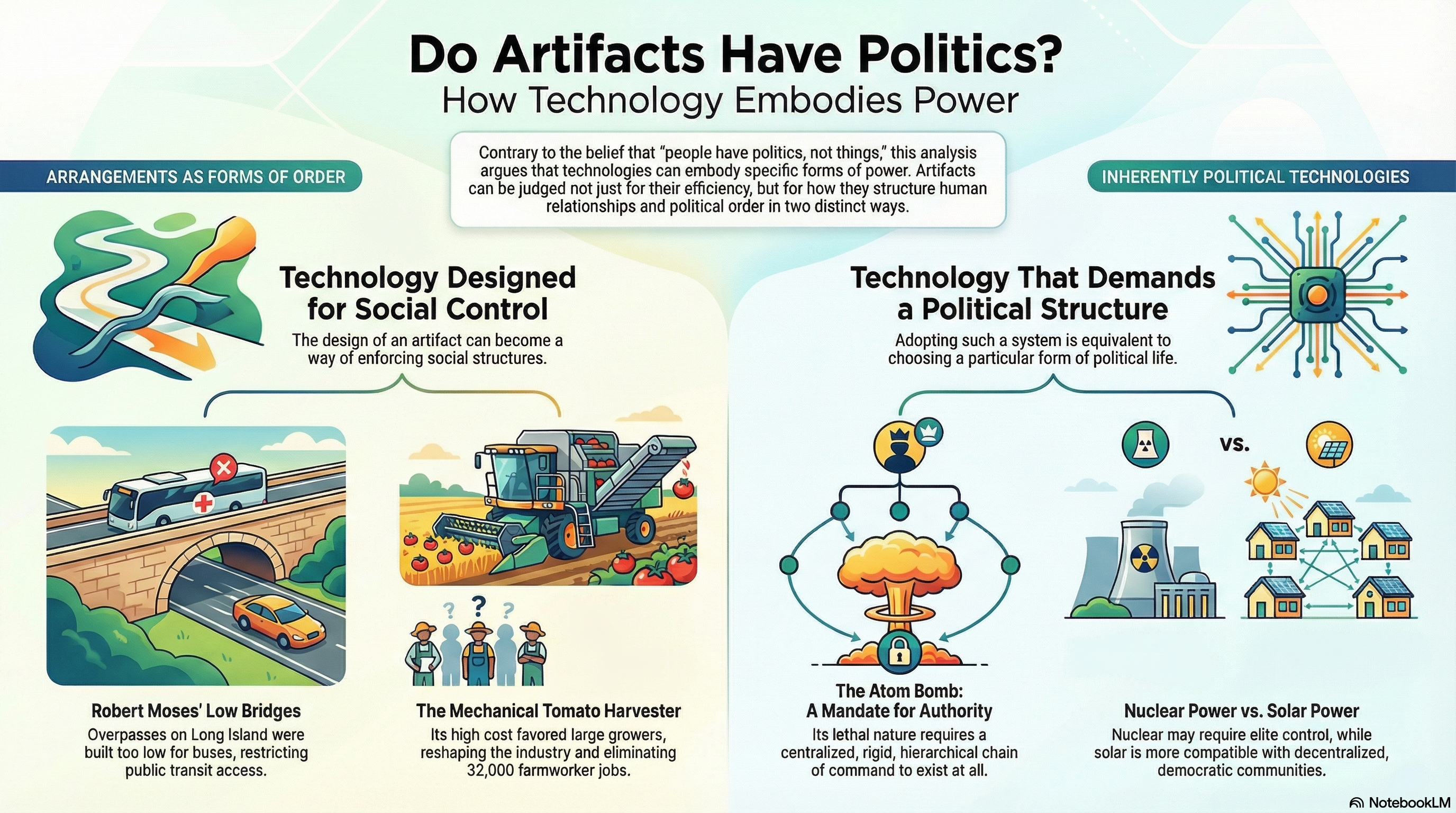
This document synthesizes Langdon Winner’s seminal argument that technological artifacts possess political qualities, challenging the conventional view of technology as a collection of neutral tools. Winner posits that the machines, structures, and systems of modern culture can embody and enforce specific forms of power and authority. He presents two primary ways in which artifacts can be political.
First, the design or arrangement of a technology can be a method for settling social issues and creating specific forms of order. These technologies are often flexible, but the choices embedded in their initial design can establish enduring social structures.
Key examples include Robert Moses’s low-hanging parkway overpasses on Long Island, intentionally designed to block buses and thus restrict access for low-income and Black communities, and the McCormick reaper factory’s adoption of inefficient molding machines solely to break a powerful labor union.
Second, Winner identifies “inherently political technologies”—systems that, by their very nature, appear to require or are strongly compatible with particular political structures. This stronger claim suggests that choosing such a technology is tantamount to choosing a form of political life.
The atomic bomb, for instance, is an inherently political artifact that demands a centralized, hierarchical, and authoritarian command structure for its control. Similarly, the widespread use of plutonium as a nuclear fuel could necessitate significant infringements on civil liberties to ensure its security. Winner argues that in modern society, the logic of “practical necessity” dictated by these technologies often eclipses other moral and political considerations, effectively reshaping human associations to fit technical requirements.
Technology as a Political Phenomenon
The core of the analysis is the provocative notion that technical artifacts have political qualities. This idea stands in contrast to the common perception that only people have politics, while things are neutral. The argument asserts that modern material culture should be judged not just for its efficiency or environmental side effects, but for how it can “embody specific forms of power and authority.”
The concept is not new and has been articulated from opposing viewpoints:
- Critics of Large-Scale Systems: Thinkers like Lewis Mumford have long argued that two types of technology have coexisted: one “authoritarian” (system-centered, powerful) and one “democratic” (man-centered, resourceful). This sentiment is echoed by modern environmentalists like Denis Hayes, who contend that nuclear power leads toward authoritarianism, whereas “dispersed solar sources are more compatible… with social equity, freedom and cultural pluralism.”
- Boosters of Technology: Conversely, proponents have often claimed that major technological advancements—from the factory system and the automobile to television and nuclear power—are inherently democratizing and liberating forces.
Beyond Social Determination
A common rebuttal to the idea of political artifacts is the theory of the “social determination of technology.” This view holds that what matters is not the technology itself, but the social and economic system in which it is developed and used. While this serves as a useful corrective to naive technological determinism, Winner argues that, taken to its extreme, it wrongly suggests that “technical things do not matter at all.”
To counter this, Winner advocates for a “theory of technological politics” which takes technical artifacts seriously. This perspective complements social determination theories by suggesting we must “pay attention to the characteristics of technical objects and the meaning of those characteristics.” It identifies certain technologies as political phenomena in their own right.
Two Ways Artifacts Contain Political Properties
Winner outlines two distinct ways in which technologies can be understood to have political qualities.
Technical Arrangements as Forms of Order
This category includes instances where the specific invention, design, or arrangement of a technology becomes a means of settling an issue within a community. These technologies are often flexible in their design, but the choices made can create enduring patterns of power and privilege.
Case Study: Robert Moses’s Low Overpasses
The approximately two hundred low-hanging overpasses on the parkways of Long Island, New York, serve as a prime example.
- Design: These bridges were deliberately built with clearances as low as nine feet by Robert Moses, the powerful New York public works builder.
- Political Purpose: According to Robert A. Caro’s biography of Moses, this design was intended to prevent twelve-foot-tall buses from using the parkways.
- Social Consequence: This effectively barred poor people and Black communities, who relied on public transit, from accessing recreational areas like Jones Beach, which was primarily for “automobile-owning whites.” Moses reinforced this by vetoing a proposed railroad extension to the beach.
- Enduring Impact: As planner Lee Koppleman noted, “The old son-of-a-gun had made sure that buses would never be able to use his goddamned parkways.” Generations after Moses, these concrete and steel structures continue to embody and enforce a “systematic social inequality.”
Case Study: Cyrus McCormick’s Molding Machines
The history of industrial mechanization shows that technological change is not always driven by efficiency, but often by the desire for social control.
- Context: In the mid-1880s, Cyrus McCormick II was in a conflict with the National Union of Iron Molders at his Chicago reaper factory.
- Technological Choice: The company invested an estimated $500,000 in new, untested pneumatic molding machines.
- Political Purpose: The explicit goal was to “weed out the bad element among the men”—the skilled, unionized workers. The new machines could be operated by unskilled labor, destroying the union’s power base.
- Outcome: The machines produced inferior castings at a higher cost and were abandoned after three years, but only after they had successfully served their primary purpose: the destruction of the union.
Systemic Bias and Unintended Consequences
Political qualities in artifacts do not always stem from conscious conspiracy.
- Handicapped Access: The historical design of buses, buildings, and sidewalks systematically excluded handicapped persons from public life, not from malicious intent, but from long-standing neglect. Rectifying this injustice now requires redesigning a wide range of artifacts.
- The Mechanical Tomato Harvester: Developed by the University of California, this machine illustrates how a technological system can be biased towards certain social interests.
- Function: The harvester picks tomatoes in a single pass, requiring the development of new, hardier (and less tasty) tomato varieties.
- Economic Impact: The machines cost over $50,000 each, making them compatible only with large-scale, concentrated farming operations.
- Social Reshaping: The introduction of the harvester led to a dramatic consolidation in the industry. The number of tomato growers in California fell from approximately 4,000 in the early 1960s to about 600 in 1973. An estimated 32,000 farmworker jobs were eliminated by the late 1970s.
- Conclusion: The harvester is not a symbol of a conspiracy but an “embodiment” of a social process where scientific research and corporate profit reinforce patterns of economic power, favoring large agribusiness at the expense of small farmers and farmworkers.
Inherently Political Technologies
This stronger claim posits that some technologies are, by their very nature, linked to specific forms of political life. The choice to adopt such a technology is also a choice for the social and political relationships that it brings with it.
In his 1872 essay “On Authority,” Friedrich Engels argued that modern industrial systems—such as cotton mills, railways, and ships at sea—are inherently authoritarian.
- Argument: The need for precise coordination and timing, “fixed by the authority of the steam,” imposes a rigid discipline on workers.
- Conclusion: Engels claimed that relationships of subordination are “imposed upon us together with the material conditions under which we produce.” He argued that nature avenges itself on humanity by subjecting us to a “veritable despotism independent of all social organization” when we employ its forces through technology.
This claim can be broken down into two distinct versions:
- Required Social Conditions: A given technology requires a particular social structure as its operating environment. An example is the assertion that “if you accept nuclear power plants, you also accept a techno-scientific-industrial-military elite.” The technology cannot function effectively without this social arrangement.
- Strong Compatibility: A technology is strongly compatible with but does not strictly require a particular social order. For instance, advocates argue solar energy is more compatible with a decentralized, democratic society than centralized energy sources like coal or nuclear power.
Case Study: The Atomic Bomb
The atomic bomb is presented as the quintessential inherently political artifact.
- Unavoidable Structure: “As long as it exists at all, its lethal properties demand that it be controlled by a centralized, rigidly hierarchical chain of command closed to all influences that might make its workings unpredictable.”
- Practical Necessity: This authoritarian internal social system is a practical necessity, regardless of the broader political regime (democratic or otherwise) in which the bomb is embedded.
Case Study: Large-Scale Managerial Systems
Alfred D. Chandler’s study The Visible Hand provides historical evidence that the technologies of the 19th and 20th centuries “required” a specific social form.
- Argument: Technologies for production, transportation (railroads), and communication necessitated the creation of “large-scale centralized, hierarchical organization administered by highly skilled managers.”
- Rationale: The scale, speed, and complexity of these systems could not be handled by the previously dominant small family firm. To work efficiently and safely, these technologies demanded a new administrative structure.
Case Study: The Plutonium Economy and Civil Liberties
The debate over nuclear power provides a modern example of how a technology’s operational requirements might reshape public life.
- The Technology: A proposed alternative to uranium fuel is plutonium, a highly toxic and weaponizable by-product of nuclear reactors.
- The Risk: The widespread use of plutonium increases the chance of theft by terrorists or other groups.
- Political Consequence: Safeguarding plutonium might require extraordinary security measures that infringe upon civil liberties, including background checks, covert surveillance, wiretapping, and the potential for martial law.
- The Compelling Logic: As legal scholar Russell W. Ayres argues, “Once recycling begins and the risks of plutonium theft become real rather than hypothetical, the case for governmental infringement of protected rights will seem compelling.” This illustrates how adopting a technology can create imperatives that justify restructuring social and political norms.
Understanding Technology and Political Order
Langdon Winner concludes by distinguishing between the two interpretations of political artifacts:
- Flexible Technologies: These possess a range of design possibilities, and their political consequences are shaped by the social actors who influence their final form.
- Intractable Technologies: These have properties so strongly linked to particular power structures that the initial decision to adopt them is the most critical choice, with little room for subsequent modification of their political effects.
The analysis advocates for a “both/and” position, recognizing that both interpretations apply in different circumstances. A complex system like a transportation network may have some flexible aspects and other intractable ones.
Ultimately, the political qualities of artifacts demand closer scrutiny. In modern times, “people are often willing to make drastic changes in the way they live to accord with technological innovation at the same time they would resist similar kinds of changes justified on political grounds.” For this reason, achieving a clear understanding of how technologies function as forms of order is a crucial enterprise for both political theory and society at large.
6 - Fairness and Abstraction
Summary
This document synthesizes a critical analysis of the fair-machine learning (fair-ML) field, which aims to develop technical systems that achieve social outcomes like fairness and justice. The central argument is that the bedrock concepts of computer science—primarily abstraction and modular design—are fundamentally mismatched with the complexities of social contexts. By abstracting away social factors, fair-ML interventions risk being “ineffective, inaccurate, and sometimes dangerously misguided.”
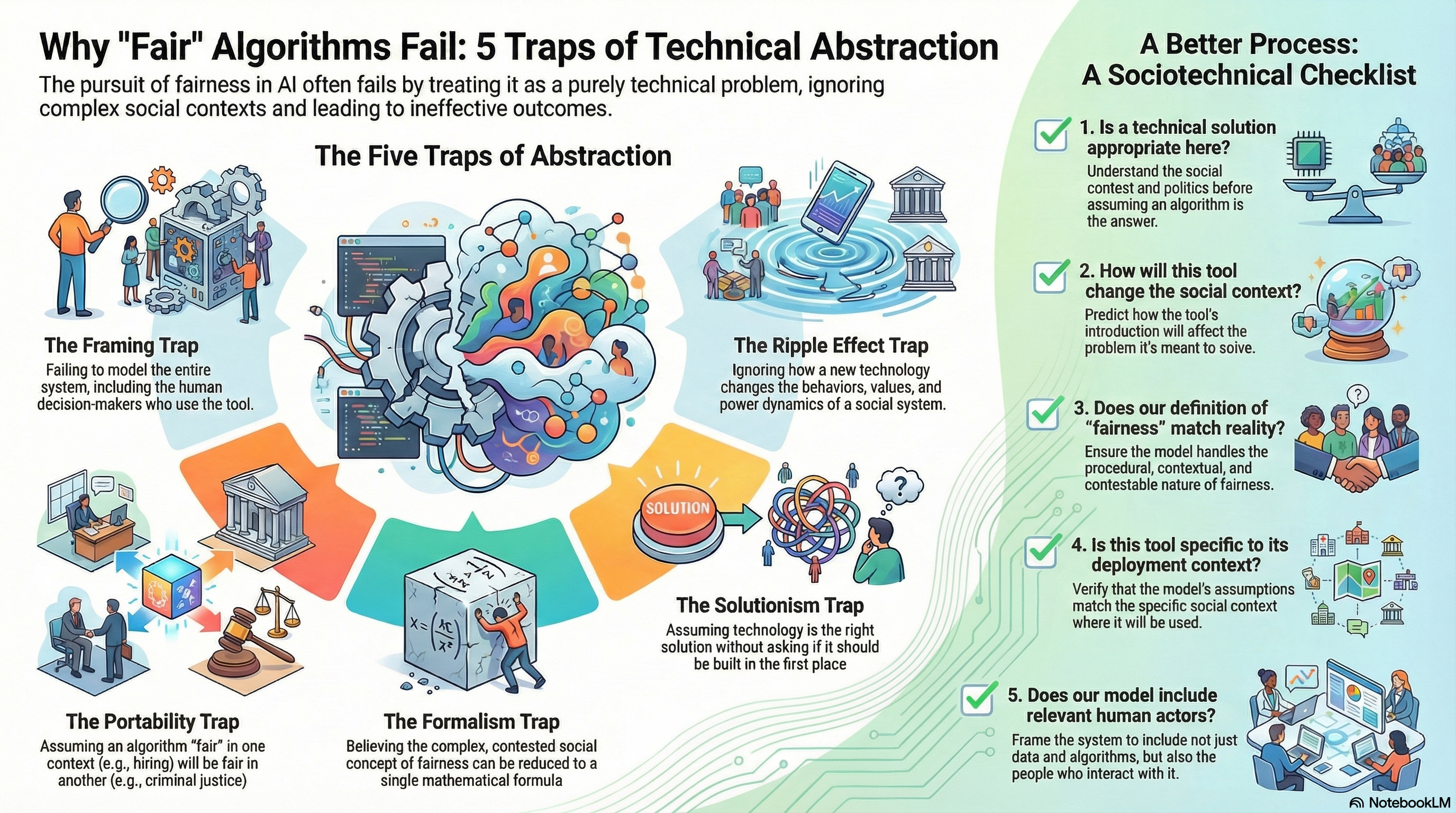
The analysis identifies five distinct failure modes, termed “Abstraction Traps,” that arise from this mismatch:
- The Framing Trap: Failing to model the entire sociotechnical system, including human actors, over which a social criterion like fairness is meant to be enforced.
- The Portability Trap: Erroneously assuming that an algorithmic solution designed for one social context can be effectively repurposed for another without harm.
- The Formalism Trap: Attempting to capture complex, procedural, and contestable social concepts like fairness within rigid mathematical definitions.
- The Ripple Effect Trap: Overlooking how the introduction of a technology changes the behaviors, power dynamics, and values of the existing social system.
- The Solutionism Trap: Defaulting to a technological fix without first considering whether technology is the appropriate solution at all.
To mitigate these traps, the analysis proposes a shift in perspective, drawing on the field of Science and Technology Studies (STS). It advocates for viewing fair-ML systems as sociotechnical systems, where humans and machines are inseparable components. This perspective calls for a move away from a solutions-oriented approach to a process-oriented one, where designers draw abstraction boundaries to include social actors and institutional contexts. The ultimate recommendation is for a fundamental reorientation of fair-ML work, prioritizing deep contextual understanding, interdisciplinary collaboration, and a willingness to conclude that sometimes the most responsible action is not to build a technical system.
A Category Error in Abstraction
The discipline of fair-ML has largely focused on engineering fairness as a quantifiable property of a technical system, much like precision or recall. This is achieved by abstracting away the social context, treating the machine learning model as a “black box” defined by its inputs and outputs. The core contention of the analysis is that this approach constitutes a fundamental error.
“Fairness and justice are properties of social and legal systems like employment and criminal justice, not properties of the technical tools within. To treat fairness and justice as terms that have meaningful application to technology separate from a social context is therefore to make a category error, or as we posit here, an abstraction error.”
By isolating the technical components, researchers miss the broader context necessary to understand or achieve fair outcomes. The proposed solution is to recognize that technical systems are always subsystems within larger sociotechnical systems.
The Five Abstraction Traps
The failure to properly account for the interaction between technical systems and their social environments leads to five distinct “traps.”
1. The Framing Trap
Definition: Failure to model the entire system over which a social criterion, such as fairness, will be enforced.
-
Algorithmic Frame vs. Sociotechnical Frame:
Most machine learning operates within an “algorithmic frame,” where inputs and outputs are taken as given and the goal is to optimize a model. Fair-ML expands this to a “data frame,” which interrogates the inputs and outputs for bias. However, this is still insufficient. A “sociotechnical frame” is required, which explicitly models the human and institutional components of the system alongside the algorithm.
-
Example: Pre-Trial Risk Assessment: A risk assessment tool may provide a “fairness guarantee” based on its scores (e.g., low, medium, high risk). However, these scores are typically recommendations to a human judge, who may exhibit automation bias, deviate from the recommendations in biased ways, or ignore them entirely. If the model does not include the judge’s decision-making process within its frame, its fairness guarantee is rendered invalid. The critical human outcomes are not the risk scores, but the judge’s decisions: release, bail, or detention.
2. The Portability Trap
Definition: Failure to understand how repurposing algorithmic solutions designed for one social context may be misleading, inaccurate, or otherwise do harm when applied to a different context.
- The Imperative of Portability: Computer science culture prizes portable, reusable code. This leads to the creation of general-purpose tools (e.g., scikit-learn, tensorflow) and fairness “wrappers” designed to be applied to any classifier.
- Context-Dependent Assumptions: These portable solutions must make assumptions about the world (e.g., that observed data accurately reflects reality). These assumptions may hold in one social context but fail disastrously in another. Fairness concerns in hiring are different from those in criminal justice. Even within the same domain, such as between different court jurisdictions, local fairness concerns can vary significantly.
- The Portability Paradox: To avoid the other traps, a designer must deeply integrate the specific social context into the model. This act of contextualization, however, makes the system inherently non-portable. To design for fairness, developers must work against the core programming imperative of creating abstract, portable tools.
3. The Formalism Trap
Definition: Failure to account for the full meaning of social concepts such as fairness, which can be procedural, contextual, and contestable, and cannot be resolved through mathematical formalisms.
- Limits of Mathematical Definitions: The fair-ML community has proposed numerous mathematical definitions of fairness. However, these formalisms are simplifications that fail to capture the true nature of concepts like fairness and discrimination.
- Three Core Missing Attributes:
- Procedurality: Legal and social fairness is often about process, not just outcomes. Firing someone for their race is illegal, while firing them for another reason is not, even if the outcome (job loss) is identical.
- Contextuality: The meaning of discrimination is deeply contextual. It depends on the attribute (race vs. religion), the social sphere (employment vs. housing), and the actor (public vs. private). As scholar Deborah Hellman argues, the concept is “wrongful discrimination,” where cultural context determines moral wrongness.
- Contestability: The definitions of fairness and discrimination are politically contested and evolve over time through legislation, court cases, and shifting social norms. To “set them in stone—or in code”—violates democratic ideals by picking a side without transparent process.
4. The Ripple Effect Trap
Definition: Failure to understand how the insertion of technology into an existing social system changes the behaviors and embedded values of the pre-existing system.
- Unintended Consequences: When a technology is introduced, people and organizations respond to it in unpredictable ways. This can undermine the technology’s intended purpose.
- Behavioral and Power Shifts: In the criminal justice context, judges may defer to a risk assessment tool because it appears rigorous, or they may resist its influence. Their usage patterns may change over time as they become more familiar with the scores. The technology becomes a resource in pre-existing power struggles, for instance between judges and probation officers.
- Value Shifts: The introduction of a quantifiable metric can unconsciously privilege the value it measures. In sentencing, risk assessments quantify the risk of reoffending (incapacitation), potentially overshadowing other rationales for punishment like rehabilitation, deterrence, or restoration.
5. The Solutionism Trap
Definition: Failure to recognize the possibility that the best solution to a problem may not involve technology.
- The Law of the Instrument: Rooted in computer science, the fair-ML field often starts with the assumption that a technical intervention is necessary (“if you have a hammer, everything looks like a nail”). This precludes an evaluation of whether the technology should be built in the first place.
- When Not to Build: A technological solution may be inappropriate in two broad situations:
- When Fairness is Contested: If the definition of fairness is politically contested and shifting, a model that requires a fixed definition will fail to capture its dynamic nature. Code calcifies these definitions.
- When the System is Intractable: The social system may be too complex to model, relying on unmeasurable attributes like political shifts or irrational human preferences. In such cases, approximations are as likely to worsen the situation as improve it, especially when stakes are high.
A Sociotechnical Perspective
Drawing from Science and Technology Studies (STS), the analysis proposes specific theoretical frameworks to understand and avoid each trap. The core principle is to embrace a sociotechnical view where social and technical elements are analyzed together.
| Trap | STS Mitigation Framework | Core Insight |
|---|---|---|
| Framing Trap | Heterogeneous Engineering | Draw the abstraction boundary to include both technical components (the algorithm) and human/social ones (a judge’s decision-making, institutional reward structures). Treat fairness as a property of this combined system. |
| Portability Trap | User “Scripts” | Recognize that technologies embed “scripts” for how they are meant to be used. These scripts break when the technology is moved to a new social and technical network. Fairness is tied to the context, not the code. |
| Formalism Trap | Social Construction of Technology (SCOT) | View the current debate over fairness definitions as a period of “interpretive flexibility.” Different “relevant social groups” (researchers, companies, impacted communities) are advancing different solutions. Designers must consciously choose which groups’ problems to solve. |
| Ripple Effect Trap | Reinforcement Politics & Reactivity | Be aware that new technology can be used to reinforce existing power structures (“reinforcement politics”) and that people will change their behavior in response to being measured (“reactivity”), potentially gaming the system. |
| Solutionism Trap | Considering When to Design | The most responsible conclusion after a thorough sociotechnical analysis may be to “shelve the technological fix.” This requires researcher humility and valuing social science research as much as algorithm development. |
A Process-Oriented Path Forward
The proposed “solution” is not a new algorithm but a reorientation toward a new process. Designers should consider the five traps, ideally in reverse order, before and during system development.
-
Is a technical solution appropriate? (Solutionism Trap)
Conduct legal and social research to understand the context. Compare the proposed technology against non-technical policy alternatives (e.g., presumptive decarceration instead of risk assessment tools).
-
How will the technology change the social context? (Ripple Effect Trap)
Anticipate value shifts and behavioral changes. Conduct pilot studies to monitor the impact of the technology on human actors (e.g., do judges actually follow recommendations?).
-
Can the system handle the complexity of fairness? (Formalism Trap)
Incorporate procedurality and contestability (e.g., build in formal processes for defendants to contest results). Actively engage with underrepresented social groups to understand their needs and avoid premature “closure” on a definition of fairness.
-
Is the system properly matched to its context? (Portability Trap)
Assume any off-the-shelf algorithm is inappropriate without modification. Clearly document the intended use cases and limitations of the code, adopting concepts like “user scripts.”
-
Is the system framed to include social actors? (Framing Trap)
Adopt a heterogeneous engineering approach. Model the human actors who are part of the system and ensure the fairness criteria apply to the true human outcome (e.g., the detain-or-release decision, not just the risk score).
By following this process, the fair-ML community can move beyond purely technical fixes and begin to design better—and more genuinely fair—sociotechnical systems. This requires deep collaboration with domain experts and social scientists, and a fundamental expansion of what it means to do computer science.
7 - Why Privacy Is Important
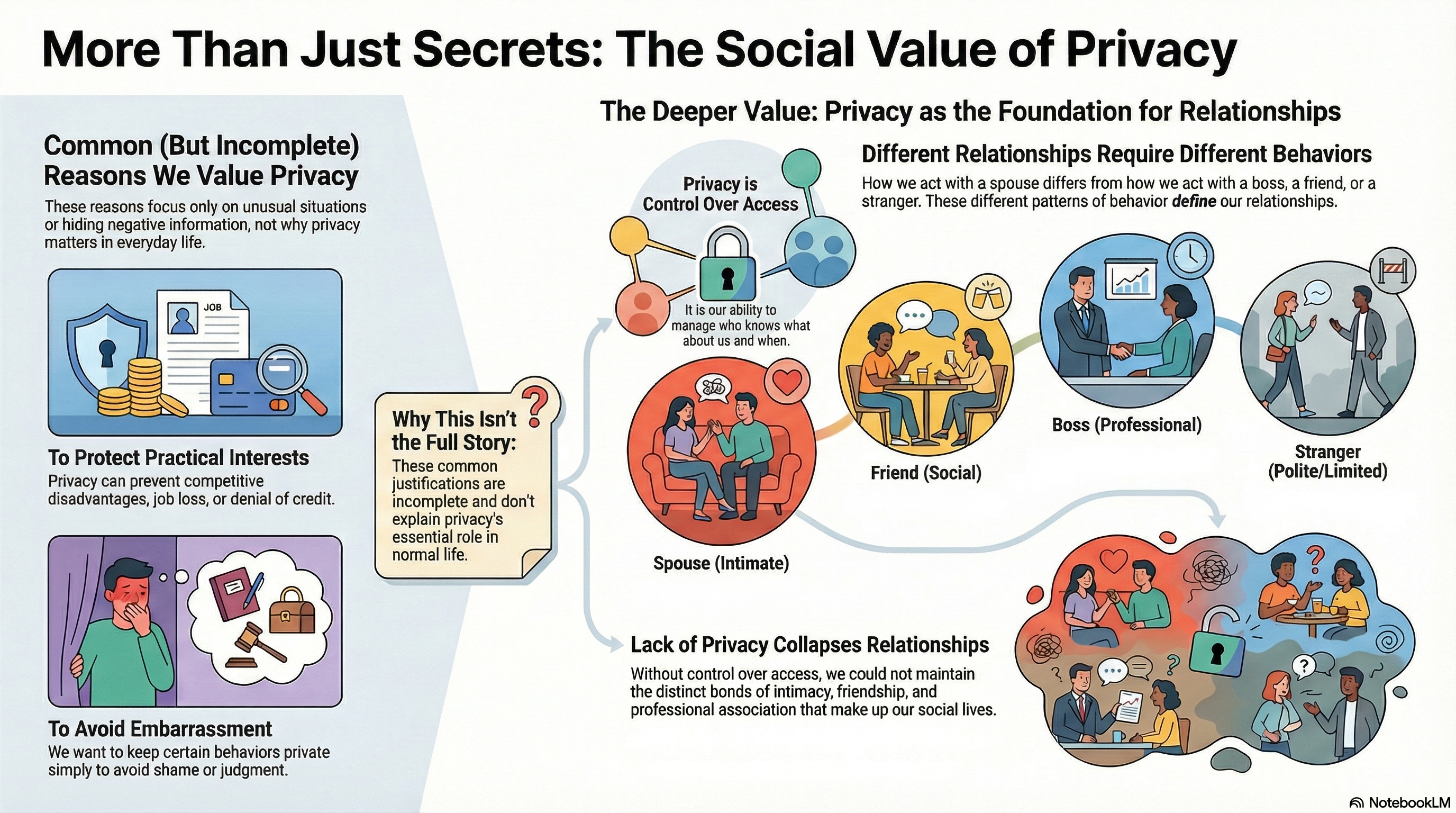
Summary
This document synthesizes the central arguments presented by James Rachels in his 1975 essay, “Why Privacy Is Important.” Rachels posits that the fundamental value of privacy lies not merely in its ability to protect individuals from embarrassment, competitive disadvantage, or specific harms, but in its essential role as a prerequisite for creating and maintaining a variety of distinct social relationships. He argues that our ability to control who has access to us and to information about us is inextricably linked to our ability to manage the different patterns of behavior and levels of intimacy that define our relationships with others—be they friends, spouses, colleagues, or acquaintances.
Rachels critiques conventional justifications for privacy as insufficient because they focus on unusual situations and fail to explain its value in ordinary life. His core thesis is that without privacy, we would lose the capacity for separation and control necessary to behave appropriately within the context of our varied social roles. This would force an untenable choice between abandoning the unique character of our intimate relationships or behaving in ways deemed inappropriate for a wider audience. Ultimately, Rachels concludes that the concept of something being “none of your business” is directly defined by the nature of our social relationships, and he defends the right to privacy as a distinct right that protects the special interest we have in managing these relational dynamics.
The Insufficiency of Conventional Explanations for Privacy
Rachels begins his analysis by examining and deconstructing several common justifications for the importance of privacy. While acknowledging their validity in specific contexts, he argues they provide an incomplete understanding of privacy’s foundational value.
The essay identifies four primary interests that privacy is often said to protect:
- Competitive Situations: Privacy is necessary to protect strategic interests. For example, a chess player like Bobby Fischer needs to analyze an adjourned position in private to avoid revealing his strategy to an opponent.
- Avoidance of Embarrassment: Individuals may wish to keep certain behaviors private simply to avoid the embarrassment of others knowing about them. Rachels cites a “splendid example” from John Barth’s novel End of the Road, where a character is observed alone, “smartly executing military commands” and “cavorting about the room.” Rachels notes, “It is indeed the grossest of injustices to observe a person who believes himself to be alone.”
- Prevention of Specific Harms: The confidentiality of personal information, such as medical records, is crucial to prevent tangible negative consequences. The disclosure of conditions like venereal disease, alcoholism, or drug abuse could lead to a wrecked marriage, job loss, or the inability to obtain insurance.
- Protection from Unfair Judgment: When individuals apply for credit, insurance, or certain jobs, investigations often compile extensive files. The inclusion of irrelevant information about an applicant’s “sex-life, his political views, and so forth” is unfair if it influences decisions in these matters.
Rachels contends that these examples fail to capture the full essence of why privacy is important for two main reasons:
- Focus on Atypical Cases: These scenarios are described as “relatively unusual sorts of situations, in which someone has something to hide or in which information about a person might provide someone with a reason for mistreating him in some way.” They do not explain the value of privacy in “normal or ordinary situations” where there is nothing shameful or threatening to conceal. For instance, married couples with “normal” sex lives still do not want their bedrooms bugged.
- Incomplete Explanation of Offense: Even when an invasion of privacy leads to a specific harm (like a poor credit rating), the objection is often twofold. Beyond the unfairness of the outcome, there is a fundamental objection based on a “sense of privacy,” a feeling that certain aspects of one’s life are “simply nobody else’s business.” An adequate theory must explain this intrinsic sense of violation.
Privacy as a Prerequisite for Social Relationships
Rachels proposes an alternative account based on the “close connection between our ability to control who has access to us and to information about us, and our ability to create and maintain different sorts of social relationships with different people.”
The foundation of Rachels’ argument is that social relationships are defined and constituted by distinct patterns of behavior and specific levels of information sharing.
- Different Patterns of Behavior: Individuals naturally vary their behavior based on their relationships. A man may be “playful and affectionate with his children,” “businesslike with his employees,” and “respectful and polite with his mother-in-law.” Rachels rejects the notion that this is hypocritical or involves wearing “masks” to hide a “true” self. Instead, these differing behaviors are expressions of different, authentic conceptions of how it is appropriate to act within each relationship. He asserts, “the different patterns of behavior are (partly) what define the different relationships; they are an important part of what makes the different relationships what they are.”
- Appropriate Levels of Knowledge: Relationships also involve a “conception of the kind and degree of knowledge concerning one another which it is appropriate for them to have.” To be a close friend, for example, involves sharing confidences and personal information. If one discovers a “friend” has shared worries or creative works with others but not with oneself, one would “have to conclude that we are not as close as I had thought.”
The Role of Control and Separation
From this premise, Rachels argues that the ability to control access to oneself is essential for maintaining these varied relationships.
- The Impact of Intrusion: The presence of a third party fundamentally alters the dynamic between individuals. When two close friends are joined by a casual acquaintance, “conversation about intimate matters is now out of order.” If these friends could never be alone, they would face a choice: either violate social norms by sharing confidences in front of the third party or abandon the behaviors that define their close friendship, eventually eroding the relationship itself.
- Privacy as a Tool for Separation: Separation is necessary to manage relationships. It “allows us to behave with certain people in the way that is appropriate to the sort of relationship we have with them, without at the same time violating our sense of how it is appropriate to behave with… others with whom we have a different kind of relationship.” Therefore, control over access—privacy—is a necessary condition for controlling the kinds of relationships one has.
The Meaning of “None of Your Business”
This framework provides a clear definition for the intuitive feeling that certain information is private.
- A fact about an individual is “someone’s business if there is a specific social relationship between us which entitles them to know.”
- Examples of Entitlement:
- A banker is entitled to know one’s financial status.
- An employer is entitled to know one’s salary.
- A spouse is entitled to know about one’s finances.
- In the absence of such a specific social relationship, one can rightly claim that a piece of information is “none of your business.”
Judith Jarvis Thomson’s “Simplifying Hypothesis”
Rachels concludes by applying his thesis to critique Judith Jarvis Thomson’s proposal that the right to privacy is not a distinct right but a cluster of other rights, primarily related to property and rights “over the person.”
Thomson suggests that rights related to privacy are simply intersections of other, more fundamental rights, such as those that give a person control over their body and their property. The right not to have one’s body looked at, in this view, is analogous to a property right.
Rachels argues this hypothesis fails because it misses the unique interest that the right to privacy protects.
- Rights Over the Body vs. Intimacy: The interest in controlling who views one’s body is fundamentally different from the interest one has in a “car or fountain pen.” It is tied to concepts of physical intimacy, which are integral to “very special sorts of personal relationships.” By treating the body as mere property, Thomson’s view “separates this right from the matters that make privacy important.”
- The Case of “Very Personal Gossip”: Rachels analyzes a scenario posed by Thomson: acquaintances spreading personal gossip (e.g., about a man’s impotence) that they obtained without violating his rights. Rachels argues that this is a violation of the right to privacy. The harm occurs because the gossip spreads “the sort of intimate fact about you that is not appropriate for strangers or casual acquaintances to know.”
- Conclusion: Since a right is violated in the gossip case that is neither a property right nor a right over the person, Thomson’s “simplifying hypothesis fails.” Rachels concludes that the right to privacy should be regarded as a “distinctive sort of right in virtue of the special kind of interest it protects”—namely, our interest in creating, maintaining, and controlling our diverse social relationships.
8 - Big Data’s Invalidation of Anonymity and Consent
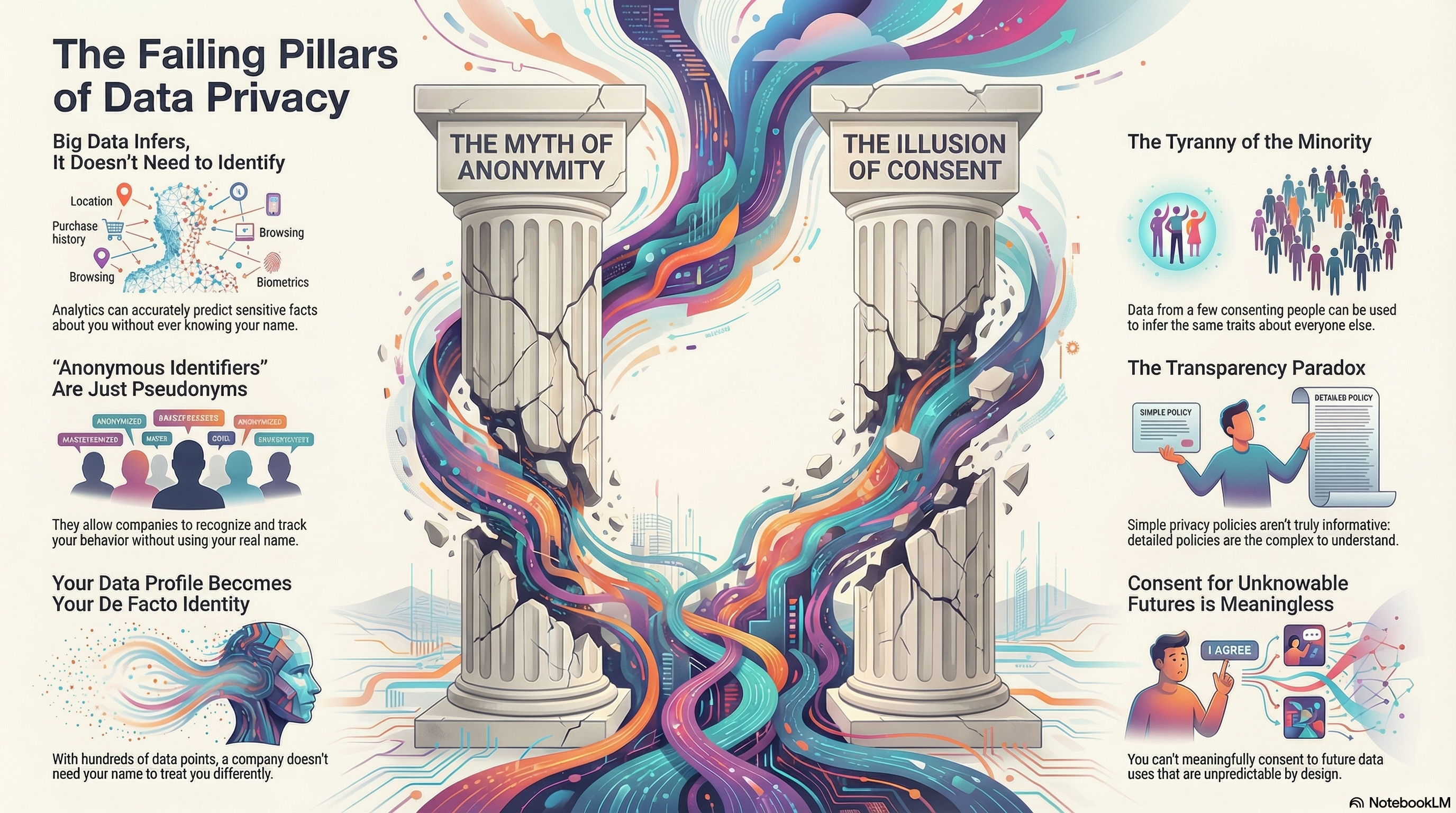
Summary
This document synthesizes the central arguments presented in “Big Data’s End Run around Anonymity and Consent” by Solon Barocas and Helen Nissenbaum. The authors contend that the two foundational pillars of privacy protection—anonymity and informed consent—are being rendered ineffective and increasingly irrelevant by the paradigm of big data. The challenge is not merely one of practical implementation but a fundamental failure of these mechanisms to address the new capabilities of big data analytics.
- Anonymity is Subverted: Even where strong technical anonymity is achieved, big data practices undermine the values anonymity traditionally protected. Individuals who are not “identifiable” in a traditional sense can still be made “reachable” and subject to consequential actions. This occurs through:
- The use of persistent pseudonyms or “anonymous identifiers.”
- The creation of comprehensive data profiles that make legal identity irrelevant.
- The power of inference, which allows for the deduction of sensitive attributes from non-sensitive data, bypassing the need for identification.
- Informed Consent is Intractable: The notice-and-consent model fails in the face of big data’s complexity, unpredictability, and scale. Core issues include:
- The Transparency Paradox: Truly accurate descriptions of data flows are too complex for users to understand, while simplified notices lose essential fidelity.
- Indeterminate Future Uses: The value of big data lies in discovering unanticipated correlations, making it impossible to specify all future data uses at the time of consent.
- The Tyranny of the Minority: Data disclosed by a small, consenting minority can be used to build predictive models that are then applied to the non-consenting majority, rendering an individual’s choice to withhold consent meaningless.
- A New Framework is Required: The authors conclude that procedural fixes cannot solve these fundamental problems. They advocate for a paradigm shift away from a sole reliance on anonymity and consent. Instead, they propose establishing a rich background of substantive rights, obligations, and context-specific ethical principles to govern data practices. In this model, consent would function not as a blanket permission but as a limited, justified waiver of specific, pre-existing protections.
Defining the Core Concepts
To understand the argument, it is essential to clarify the authors’ definitions of “big data” and “privacy.”
Big Data as a Paradigm
The term “big data” is treated not as a specific technology but as a paradigm—a framework for generating knowledge, guiding action, and rationalizing decisions. Its fundamental characteristic is a belief in the power of patterns, structures, and models derived inductively from massive, finely observed datasets. This paradigm is challenging established decision-making traditions in diverse fields, from science and governance to marketing and finance.
Privacy as Contextual Integrity
The document adopts the theory of “contextual integrity” to define privacy. In this view, privacy is not simply about control or secrecy, but about the appropriate flow of personal information according to established social norms within a specific context. These norms are defined by three key parameters:
- Actors: The sender, recipient, and subject of the information (e.g., doctor, patient, insurer).
- Information Types: The nature of the information being shared (e.g., diagnosis, symptoms).
- Transmission Principles: The constraints governing the flow (e.g., confidentiality, consent).
Big data fundamentally disrupts these entrenched informational norms. Evaluating these disruptions requires assessing whether they advance or undermine key ethical values like fairness, justice, autonomy, and context-specific goals (such as public health).
The Failure of Anonymity
Anonymity has long been considered an attractive solution to privacy challenges, as it seemingly removes data from the scope of privacy by breaking the link to an identifiable person. However, the authors argue that while debates have focused on the technical difficulty of achieving robust anonymization (i.e., preventing re-identification), the more profound issue is that big data subverts the very purpose of anonymity, even when identification is not possible.
Commercial entities often claim to use “anonymous” data when they are actually using pseudonyms—unique persistent identifiers that are not tied to a person’s legal name.
- Persistent Recognition: These identifiers, such as Google’s AdID, are designed to recognize the same person (or their device) over time, associate behaviors with their record, and tailor services accordingly.
- Misleading Terminology: Calling these identifiers “anonymous” is an oxymoron. Their purpose is identification for a specific data controller, even if they don’t use traditional Personally Identifiable Information (PII) like a name.
- The Goal of Unreachability: The traditional value of anonymity was in making individuals “unreachable”—safe from being tracked, held accountable, or punished. Pseudonyms used for tracking and targeting directly contradict this goal.
“If its very purpose is to enable Google to identify (i.e. recognize) the same person on an ongoing basis, to associate observed behaviors with the record assigned to that person, and to tailor its content and services accordingly, AdID is anonymous only insofar as it does not depend on traditional categories of identity (i.e. names and other PII).”
When data profiles become sufficiently rich and detailed, the absence of a legal name becomes meaningless.
- Comprehensive Profiling: A company may have hundreds of data points associated with a pseudonymous profile, allowing it to treat that person in a highly individualized manner.
- Industry Perspective: The focus is on attributes, not names. As one source states, “The beauty of what we do is we don’t know who you are […] We don’t want to know anybody’s name. […] All we want to do is […] have these attributes associated with them.”
- Autonomy and Justice at Risk: This capability allows organizations to act upon individuals—limiting choices, reinforcing stereotypes, and engaging in differential treatment—under the cover of anonymity, threatening core values like autonomy and social justice.
As researcher Joseph Turow asks, “[i]f a company knows 100 data points about me in the digital environment, and that affects how that company treats me in the digital world, what’s the difference if they know my name or not?”
The Power of Inference
The most significant challenge to anonymity is data mining’s ability to infer new, often sensitive, facts about individuals without needing to know their identity.
- Inference Over Identification: Instead of linking datasets using a common identifier (like a name) to find more information, data mining finds correlations that allow it to guess or predict attributes. For example, a medical condition could be inferred from a set of observable, non-medical behaviors.
- Bypassing PII: This capability makes PII less relevant for predictive modeling. As one engineer noted, “We don’t want the name. The name is noise.” There is enough information in behavioral data to learn about someone indirectly.
- Perverse Effects of Research: Even privacy-preserving research on anonymized data can create new risks. A study that successfully identifies patterns of depression from internet traffic, for example, creates a model that can then be used to make inferences about the general population, making them vulnerable in ways anonymity was meant to prevent.
The Failure of Informed Consent
Informed consent, operationalized online through notice-and-choice mechanisms like privacy policies, is the other primary tool for privacy protection. It is seen as a way to respect individual autonomy. The authors argue that this model is collapsing under the weight of big data for reasons that go far beyond the well-known problem that users don’t read the terms.
The Transparency Paradox
There is a fundamental conflict between the need for simplicity and the need for completeness in privacy notices.
- Complexity of Data Ecosystems: Modern data environments, such as programmatic advertising, involve a labyrinthine network of actors, data flows, and purposes.
- Simplicity vs. Fidelity: To be truly informative, a notice would have to detail this complexity, overwhelming any user. A simplified, “plain-language” notice, while easy to read, inevitably loses fidelity and fails to inform the user about what they are actually agreeing to.
“The detail that would allow for [a considered decision] would overwhelm even savvy users because the practices themselves are volatile and indeterminate…”
Indeterminate and Unpredictable Uses
The core value proposition of big data analytics is the discovery of unexpected insights and future uses for data that are unknown at the time of collection.
- A ‘Blank Check’: Asking for consent under these conditions is tantamount to asking for a “blank check.” It is impossible to specify all future data recipients, analytical methods, or potential inferences that might be drawn.
- The Scope of Notice: It is unclear whether notice should cover only the data explicitly collected (e.g., smart meter readings) or also all the information that can be derived from it (e.g., household occupancy, daily routines, appliance ownership), especially when combined with other datasets.
- Meaningless Consent: When future uses and consequences cannot be delimited, consent ceases to be meaningful.
The Tyranny of the Minority
Perhaps the most conclusive argument against the efficacy of individual consent is that the choices of a few can eliminate the privacy of the many.
- The Mechanism: Data voluntarily disclosed by a small group of people (the minority) is used to train machine learning models. These models discover correlations between the disclosed sensitive attribute and other, more easily observable behaviors. The model can then be used to infer that same sensitive attribute for everyone else (the majority), regardless of whether they consented.
- The Target Example: Target used its baby shower registry data (a small, consenting minority) to identify purchasing patterns that predicted pregnancy. It then applied this predictive model to its entire customer base to identify pregnant shoppers who had not disclosed their status.
- Withheld Consent Becomes Irrelevant: An individual’s decision to withhold consent makes no difference to how they are treated if an organization can accurately infer the relevant information from the data of others.
- A Critical Threshold: Research shows that when as few as 20% of users in a network reveal an attribute, that attribute can be inferred for the entire population. This creates a disincentive for companies to seek consent from more than the minimum number of people needed to build a generalizable model.
“The volunteered information of the few can unlock the same information about the many…Withholding consent will make no difference to how they are treated!”
A Call for a New Paradigm
The authors argue that the paradigm shift of big data demands a corresponding shift in our response. Continuing to focus on improving the failing procedural mechanisms of anonymity and consent is a futile effort.
Shifting from Foreground to Background
Current privacy frameworks, like the Fair Information Practice Principles (FIPPs), have placed an impossible burden on the “foreground” act of notice and consent, expecting it to define the entire relationship between a data subject and a data controller. The authors propose bringing the “background” into focus.
Drawing an analogy to informed consent in bioethics, they argue that consent should not be a mechanism for establishing rules from a blank slate. Instead, it should operate as a limited and selective waiver of rights that exist against a rich backdrop of established social and legal expectations, professional obligations, and ethical standards.
- Establish Baseline Protections: The focus should be on defining and enriching this background of rights and legitimate expectations for data practices.
- Consent for Departures Only: Notice and consent would only be required for practices that depart from these established norms.
- Justification is Required: The data collector would bear the burden of justifying why a waiver is needed and why the data subject has good reason to grant it.
Ultimately, the argument is a call to shift the debate away from procedural formalities and toward a substantive evaluation of data practices themselves. The critical question is not whether someone clicked “I Agree,” but whether the purposes and outcomes of data use are consistent with individual interests and foundational ethical, political, and context-specific values.
9 - The Case for Free Software
Summary
This document synthesizes the core arguments presented by Richard Stallman in the essay “Why Software Should Be Free.” The central thesis is that the concept of software “ownership”—the power to restrict its sharing, study, and modification—is fundamentally detrimental to society. Stallman posits that proprietary software models, while profitable for developers, create artificial obstructions that reduce overall societal value. This system leads to significant material and psychosocial harm by limiting program use, preventing user adaptation, and hindering the advancement of software development.
The essay argues for a paradigm shift toward “free software,” defined by user freedom, not price. Stallman contends that creativity and development will persist without proprietary models, driven by intrinsic motivations like the joy of programming and funded through alternative means such as service-based businesses, university research, hardware manufacturer support, and non-profit foundations. Ultimately, the free software movement is presented as an ethical and practical necessity to foster cooperation, increase overall productivity, and counteract a societal decay into self-interest and “combat.”
Public Good vs. Private Profit
The essay’s central question is how decisions regarding software use and distribution should be made. It critiques the prevailing assumption that these decisions should be based on maximizing developer profits, a criterion that has led to the legal framework of software “ownership.”
Stallman proposes an alternative criterion for judgment: “the prosperity and freedom of the public in general.” This perspective necessitates a cost-benefit analysis for society as a whole, treating current laws and practices not as foregone conclusions but as policies to be ethically scrutinized. The core of the argument is that ethics should inform the law, not the reverse.
The conclusion is that programmers have an ethical duty to write and encourage “free” software—software that others are free to share, redistribute, study, and improve.
A Critique of Justifications for Proprietary Software
The essay directly refutes the two primary arguments used to justify the proprietary model where programs are treated as private property.
The Emotional Argument
- The Claim: “I put my sweat, my heart, my soul into this program. It comes from me, it’s mine!”
- The Refutation: This feeling of attachment is dismissed as cultivated and not inevitable. Stallman points out that the same programmers willingly sign over all rights to corporations for a salary, at which point the “emotional attachment mysteriously vanishes.” He contrasts this with medieval artisans who did not even sign their work, valuing the purpose and completion of the work over personal attribution.
The Economic Argument
- The Claim: “I want to get rich… and if you don’t allow me to get rich by programming, then I won’t program… so nobody will ever program.”
- The Refutation: Stallman identifies this as a “bluff” and highlights a critical fallacy in its common formulation. The argument typically presents a false choice between proprietary software and no software. This ignores the third and superior possibility: free software. The linkage between software development and an “owner” who restricts its use is a specific policy choice, not an inherent necessity. The essay argues for decoupling development from restriction.
Removing the “Toll Booths”
To analyze the impact of proprietary models, Stallman proposes examining two activities independently: the development of software and the restriction of its use. The central argument is that restricting the distribution of an already-developed program is inherently harmful.
This is illustrated with an analogy to road construction:
- Toll Roads: One could fund all road construction with tolls, creating an incentive for development. However, toll booths are “an artificial obstruction” that degrades the road system.
- Free Roads: Roads without tolls are cheaper to build and run, safer, and more efficient to use. They offer more benefit to society at less cost.
- The Conclusion: Society is better off funding roads in a less obstructive way and making their use free once built. The toll booth not only raises funds but also degrades the road’s value.
- Application to Software: Similarly, imposing “toll booths” on software makes it more expensive to construct and distribute and less efficient to use. Restricting access to something that can be copied at near-zero marginal cost is a qualitative, harmful change.
The Harms of Obstructing Software
The essay outlines three levels of material harm caused by proprietary software, each with a corresponding psychosocial harm that damages society’s fabric.
| Level of Harm | Material Harm | Psychosocial Harm |
|---|---|---|
| First Level | Obstructing Use of Programs • Fewer people use the program because license fees are a significant disincentive. • The process is inefficient, as development costs are not offset by maximum user satisfaction. • Central distribution (disks, packaging, shipping) is wasteful. | Damaging Social Cohesion • License agreements force users to “betray” their neighbors by promising not to share. • This downgrades the importance of public spirit and helping others. • Users who share anyway often feel guilty, concluding that being a good neighbor is “naughty or shameful.” |
| Second Level | Obstructing Custom Adaptation • Users receive executable files (“incomprehensible numbers”) but not the human-readable “source code.” • Only the owner can fix bugs or adapt the program, creating a monopoly on changes. • This leads to wasted effort, as users must either write new programs from scratch (as in the bank example) or endure flawed software (as in the MIT Xerox printer example). | Damaging the Spirit of Self-Reliance • Living with tools that cannot be rearranged to suit one’s needs is demoralizing. • It leads to resignation, discouragement, and unhappiness, which can spread to other aspects of life. |
| Third Level | Obstructing Software Development • Prevents the evolutionary process where developers improve and “cannibalize” existing programs. • Hinders education, as students cannot study the source code of large programs to learn advanced skills. • Prevents developers from “standing on the shoulders of others,” except those within their own company. | Damaging the Spirit of Scientific Cooperation • In contrast to past scientific norms of open collaboration, proprietary models encourage secrecy. • Researchers in computer science often publish papers without releasing the source code, preventing replication and learning. This is described as a destruction of cooperation spared even by international war. |
The Viability of Free Software Development
The essay argues that eliminating software copyrights would not halt progress. While it might initially lead to less software being developed, that software would be more useful. Furthermore, development can be encouraged through alternative means.
Intrinsic Motivation: “Programming is Fun”
- Programming is compared to fields like classical music and archaeology, where people participate for fascination and perceived social value, not immense wealth.
- The idea that programmers require high pay is a recent phenomenon that emerged in the 1980s. Before that, “computer addiction” was a known concept, highlighting that people loved programming for its own sake.
- By removing the possibility of great wealth, attitudes can readjust, and people will once again be motivated by “the joy of accomplishment.”
Alternative Funding and Support Models
- Hardware Manufacturers: It is in their interest to support software development to make their hardware useful, as they did in the 1970s.
- Universities: Academic institutions can support free software projects through the same grants that currently fund proprietary research.
- Service-Based Income: Programmers can earn a living by selling services related to free software, such as porting, customization, and teaching. Stallman cites his own work and the emergence of a “software support industry.”
- New Institutions: The Free Software Foundation is presented as a model. As a charity, it hires programmers using funds from donations and sales of free software copies (where “free” refers to freedom, not price).
Broader Philosophical Considerations
Software Productivity
The concept of “software productivity” is redefined.
- Limited Sense: The productivity of individual projects, which is the typical focus of researchers.
- Overall Sense: The productivity of all software development in society. Free software dramatically increases overall productivity by:
- Allowing wider use of each program.
- Enabling adaptation instead of starting from scratch.
- Improving programmer education.
- Eliminating duplicate development efforts.
Competition vs. Combat
- Constructive Competition: Trying to achieve more or outdo what others have done. This can benefit everyone.
- Combat: Trying to impede rivals instead of advancing oneself.
- Proprietary software is categorized as a harmful form of combat among citizens, where withholding information becomes a primary strategy.
The Premise of Equality
The essay’s argument rests on the premise that “a user of software is no less important than an author.” This contrasts with the “owner supremacy premise,” which holds that an author’s employer is fundamentally more important. Stallman argues that the owner supremacy view is a radical right-wing assumption, not a traditional part of American legal tradition, citing the U.S. Constitution and the Supreme Court case Fox Film v. Doyal to show that the purpose of copyright is the “general benefits derived by the public.”
Conclusion: A Jungle or a Cooperative Society
The essay concludes by framing software hoarding as a symptom of a broader societal trend of disregarding public welfare for personal gain. This “antisocial spirit” leads to a society that “decays into a jungle.” The free software movement is offered as a constructive alternative in one domain—an efficient system that “encourages and runs on voluntary cooperation.” The final message is a call to change attitudes and promote the idea that a good citizen is one who cooperates, not one who is merely successful at taking from others.