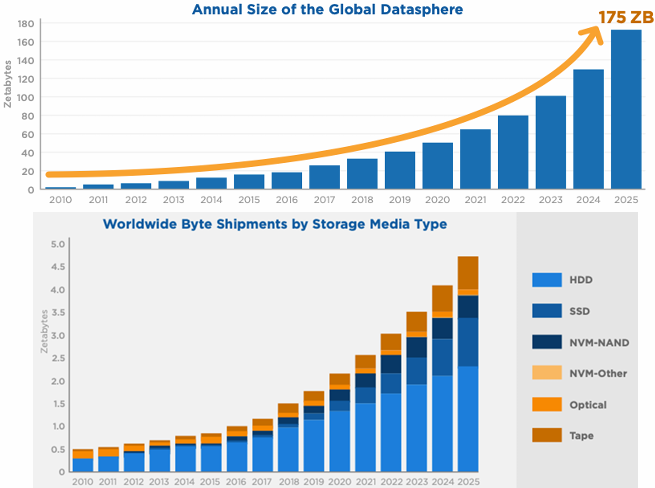
Nowadays, the world is data-driven. While in 80s-90s data was primarily generated by humans, today machines generate data at un unprecedented rate. Not only big-data source like media, but also sensors, surveillance cameras, digital medical images, etc. All this data are used in AI and Industry 4.0. The data is stored in data centers, which are growing in size and complexity.
The growth favors the centralized storage strategies, which are limiting the redundant data, automating replication and backup and reducing the management costs.
Storage Technologies
Storage technology is dominated by HDDs, magnetic disks with mechanical interactions. “Recent” technology advancement brought SSDs, with no mechanical parts and built out of transistors (NAND flash devices). Now, the fastest storage technology is the NVMe (Non-Volatile Memory Express), which is a protocol that allows to access the storage devices directly from the PCIe bus, without the need of a storage controller. These incredibly fast devices, however, do not replace the ancient tape storage, which is still used for long-term (cold data) storage.
Possible solutions, and common in many computing devices, are the hybrid storages, which combine the speed of SSDs with the capacity of HDDs. Some large storage servers use SSD as a cache for several huge HDDs. Some mainboards of the latest generation have the same features: combine small SSDs with large HDDs to have a fast and large storage.
Some manufacturers produce storage devices with a mix of SSD and HDD, called SSHD (Solid State Hybrid Drive). These devices have a small SSD and a large HDD, and the SSD is used as a cache for the HDD. The SSHD was a good solution for laptops, but now the SSDs are so cheap that the SSHD is not so common. The SSHD is still a good solution for desktops (for example, SSHD were used by Apple in the iMac from 2012 to 2020).