The operational portfolio, in essence, encompasses the core activities and processes that directly contribute to the production of goods or the delivery of services. In the manufacturing sector, this portfolio is intricately linked to the physical transformation of raw materials into finished products. It involves managing the flow of materials, optimizing production processes, ensuring quality control, and maintaining equipment.
Conversely, in the service industry, the operational portfolio focuses on the delivery of intangible services to customers. This involves managing service delivery processes, ensuring customer satisfaction, and optimizing resource allocation.
Example
For example, in a software-as-a-service (SaaS) company, the operational portfolio would include activities such as customer support, server maintenance, software updates, and user experience optimization.
The distinction between the operational portfolio in manufacturing and services highlights the fundamental differences in their core activities. Manufacturing deals with tangible goods and physical processes, whereas services deal with intangible experiences and customer interactions. This difference necessitates distinct management strategies and operational structures.
In contrast, the administrative portfolio, which includes functions like human resources, finance, and legal, remains relatively consistent across both manufacturing and service industries. These functions provide essential support and infrastructure, regardless of the company’s primary output. Similarly, the executive portfolio, which involves strategic planning, corporate governance, and leadership, is also generally uniform across different sectors. The executive level is concerned with the overall direction and performance of the organization, irrespective of whether it produces goods or delivers services.
Service Value Chain
While manufacturing companies produce tangible products made of physical materials (atoms), service companies provide intangible services, often represented by digital information (bits). This inherent difference shapes how these industries operate, particularly in how they implement IT solutions.
In the service sector, production and distribution are often inseparable. Unlike manufacturing, where products are produced, stored in warehouses, and distributed when needed, services are typically generated and delivered simultaneously. For example, in the banking industry, transferring money between accounts happens in real-time as soon as a customer initiates the request through a bank branch, an online platform, or a mobile app. The service itself is not stored but created at the moment of the transaction.
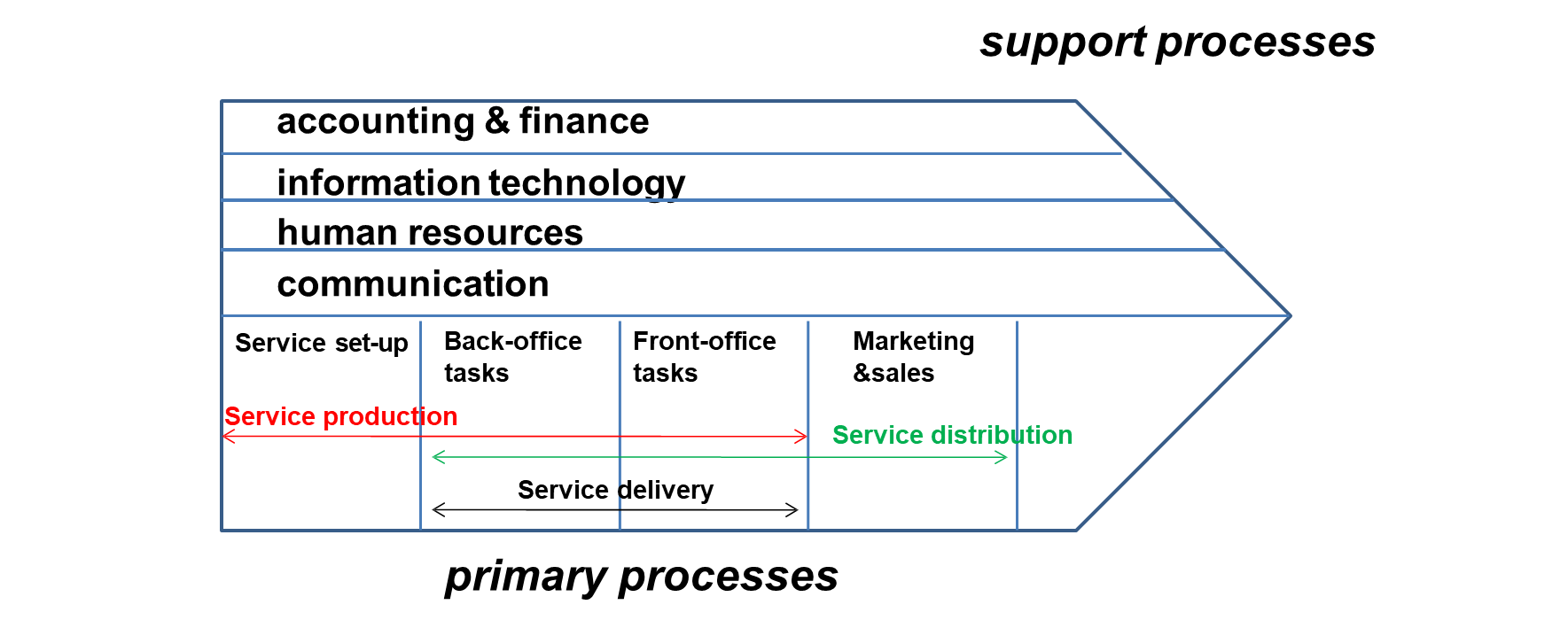
Information Technology (IT) plays a dual role in service companies. It serves both as a production tool and a distribution channel. In contrast, within manufacturing, IT is primarily a support tool for managing processes, logistics, and operational plans. In the service industry, IT systems often execute services directly, as in the case of automated financial transactions or customer service chatbots. This makes IT a critical component of both service production and delivery.
To conceptualize these changes, Michael Porter introduced a revised value chain for the service industry. Unlike the traditional manufacturing value chain, which distinctly separates production and distribution, the service value chain introduces the concept of service delivery. Service delivery encompasses tasks that blend production and distribution, forming a distinct category in the service sector.
Service delivery captures the overlap between production and distribution. While some activities remain purely production-focused (e.g., setting up a new bank branch) and others are purely distribution-oriented (e.g., marketing campaigns), many tasks involve elements of both. When a customer interacts with a bank’s website to transfer money, the service is simultaneously delivered and produced. This real-time interaction exemplifies service delivery.
Porter’s model divides the primary processes in a service company into four categories:
Definition
Service Setup:
This includes all activities necessary to establish the company’s production capacity. In banking, for example, service setup involves opening new branches, installing IT infrastructure, hiring employees, and training staff. These tasks ensure that the company can deliver its services effectively. As service companies expand into new regions or introduce new offerings, service setup remains an ongoing process.Back Office Tasks:
Back office operations involve tasks that are carried out without direct customer interaction. These often include transaction processing, account management, and compliance checks. While many back office processes are automated, some require human oversight, especially for large financial transactions that may need additional authorization. Errors in data entry or compliance issues also necessitate manual intervention. Despite ongoing automation advancements, achieving a completely automated back office (referred to as a “zero back office”) remains challenging.Front Office Tasks:
Front office tasks refer to activities performed in the presence of the customer, whether physically or virtually. Examples include assisting customers at bank branches, conducting live video consultations, or supporting customers through mobile apps. These tasks are an essential part of service delivery since they require real-time interaction.Marketing and Sales:
Unlike service setup, marketing and sales are entirely distribution-focused. These processes involve promoting services, acquiring customers, and facilitating purchasing decisions. In the banking sector, this may include advertising loan offers, providing information on interest rates, or assisting customers in opening accounts through online portals.
Inter-Functional Information Processes
Another major difference between service and manufacturing industries is the absence of materials management in services. Since services are intangible and not stored in physical inventory, traditional material management systems are irrelevant. Instead, service companies rely on knowledge management to manage digital information, customer data, and procedural knowledge.
Knowledge management systems ensure that employees and automated systems can access relevant information to perform tasks effectively. For example, in banking, a knowledge management system may provide real-time customer information to support representatives, ensuring a seamless service experience.
Furthermore, service companies integrate order management with operational management. Unlike manufacturing, where orders are typically managed separately from production, service companies often treat order management as an extension of the production process. In this context, order management involves tracking customer requests and ensuring the service is produced and delivered in real-time.
Knowledge Management
Knowledge management is a critical concept in modern service industries, yet it can often be challenging to grasp due to its abstract nature and relatively recent development. Unlike tangible manufacturing processes, knowledge management deals with the effective capture, storage, and application of knowledge that is gathered during service production. This information can then be transformed into actionable insights to improve future service delivery, ensuring customer satisfaction and fostering long-term customer relationships.
One of the primary reasons knowledge management is particularly relevant in services is that service production and distribution often occur simultaneously. For instance, when you visit a university’s student office to resolve an academic issue, the secretary provides both the service and the resolution at the same moment. This differs significantly from manufacturing, where products are created, stored, and delivered separately.
In a typical scenario, students may not need to visit the secretary’s office for routine services, as many interactions can occur online. However, when issues arise—especially those that involve exceptions or deviations from standard procedures—customers often prefer face-to-face interactions with a human representative. This is because human agents possess the flexibility and empathy necessary to address individual concerns that automated systems often cannot handle.
Example
Consider a case where an international student faced an issue with course credit recognition due to discrepancies between their home university’s system and the host institution’s. Despite contacting the student office via email, the student received a standardized response that failed to resolve the issue. However, after escalating the matter, a professor intervened and proposed a personalized solution — providing a signed letter to validate the student’s performance in part of the course.
This case exemplifies knowledge management in action. The student’s unique problem was identified, analyzed, and resolved using human judgment. Effective knowledge management would ensure that such solutions are documented, forming a knowledge base that can be referenced for future cases. By recognizing patterns in exceptions, the student office can implement streamlined processes like pre-defined forms or automated exception handling, reducing the time and effort required to address similar issues in the future.
Customers often expect services to be flexible and tailored to their specific needs. Unlike standardized products, services are dynamic and can be adjusted in real time. When organizations lack the ability to adapt to unique customer needs, dissatisfaction increases. Knowledge management empowers service providers to record and analyze past interactions, predict similar issues, and proactively create adaptable service solutions.
A similar example is customer service in e-commerce platforms like Amazon. While automated systems handle most issues efficiently, exceptions may require human intervention. Persistent customers might eventually escalate their concerns until they reach a human representative capable of making informed decisions.
Implementing Knowledge Management Systems
For knowledge management to be effective, organizations must establish systematic processes to capture and analyze customer interactions. This involves:
Steps
Recording Issues and Solutions: Every time a customer encounters a problem, it should be documented. This includes not only the issue itself but also the resolution and any decisions made.
Building a Knowledge Repository: Organizations should create centralized databases that store information on past cases. These repositories enable employees to retrieve similar scenarios quickly, facilitating faster problem resolution.
Training and Continuous Learning: Employees should be trained to leverage knowledge management systems effectively. Encouraging a culture of learning and collaboration ensures that solutions are continuously refined and updated.
Using Advanced Technologies: Emerging technologies, particularly large language models (LLMs) and artificial intelligence, play a crucial role in knowledge management. These systems can process large volumes of unstructured data, extract insights, and even recommend solutions based on historical patterns.