Synthesizing Reality
Definition
Synthetic data refers to artificially generated datasets that replicate the statistical properties, distributions, and patterns of real-world data while containing no actual observations from the original dataset.
The primary purpose of synthetic data is to serve as an alternative to real data, particularly in cases where data collection is limited, costly, or restricted due to privacy regulations. By ensuring that synthetic data retains the essential characteristics of real-world data, it becomes a powerful tool for training machine learning models, conducting simulations, and exploring hypothetical scenarios in a controlled environment. Its ability to be produced in large quantities makes it particularly useful in situations where real-world data is scarce or imbalanced. Additionally, synthetic data can be designed to include rare events or extreme cases that may not be present in the original dataset, thereby improving model robustness and generalization.
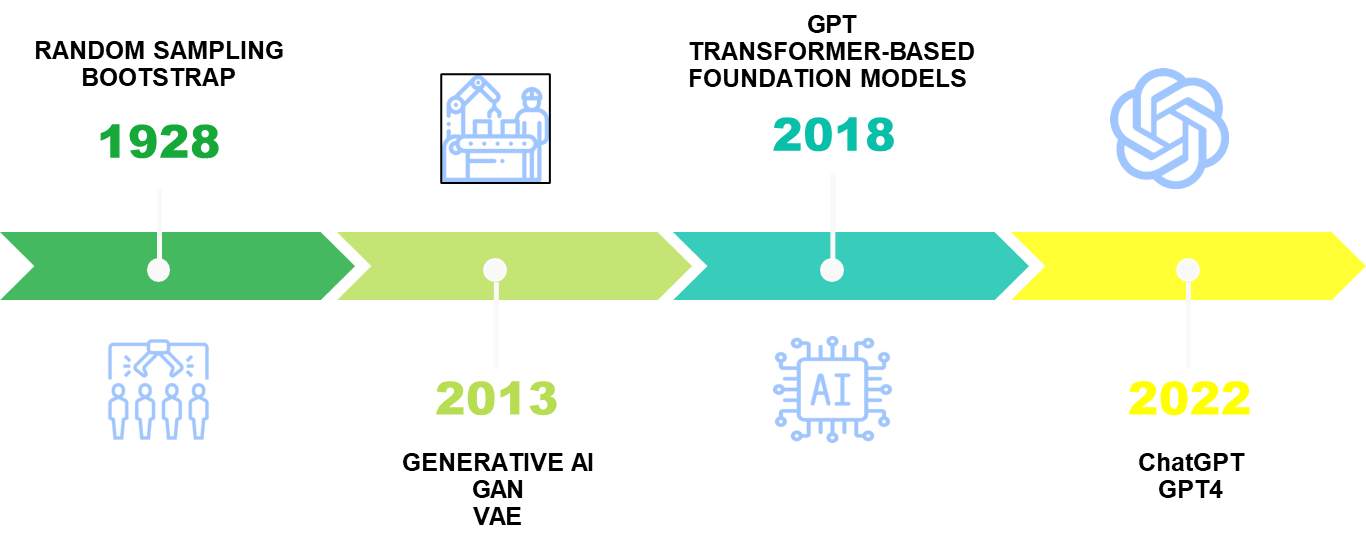
The concept of synthetic data has been in development for over a century, with early forms appearing in statistical simulations and Monte Carlo methods. However, recent advancements in artificial intelligence and deep learning have significantly enhanced the ability to generate high-quality synthetic datasets. Modern techniques such as Generative Adversarial Networks (GANs) and Variational Autoencoders (VAEs) have revolutionized the field, enabling the creation of synthetic images, text, and structured data that closely resemble real-world distributions.
One of the most compelling aspects of synthetic data is its ability to enable the exploration of hypothetical scenarios. By leveraging the underlying mechanisms that generate real-world events, synthetic data can be used to simulate new conditions that have not yet been encountered.
Example
In finance, synthetic data can be used to model extreme market conditions, allowing analysts to study potential crises before they occur. In marketing, businesses can simulate different customer behavior patterns to optimize advertising strategies. Additionally, in supply chain management, synthetic data can be used to predict raw material costs under rare or uncertain conditions, helping companies prepare for disruptions.
Advantages of Synthetic Data
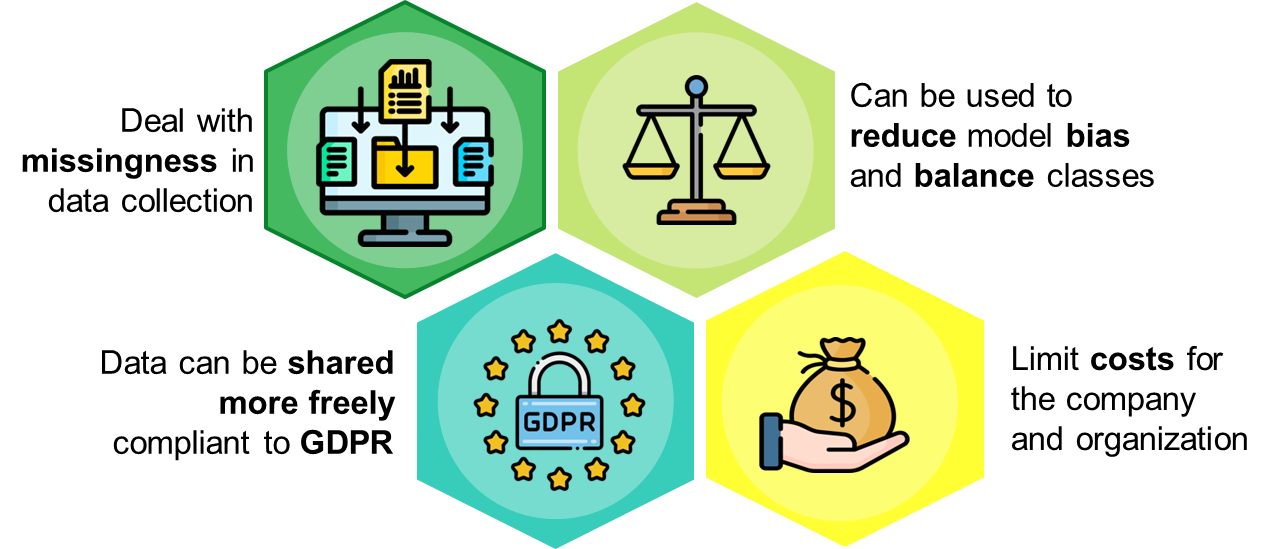
One of the key advantages of synthetic data is its ability to address issues related to missing data. In many real-world scenarios, data collection processes suffer from incomplete or biased datasets, making it difficult to train accurate predictive models. Synthetic data can supplement these datasets by filling in missing information while maintaining the statistical integrity of the original data.
Another significant benefit of synthetic data is its compliance with data protection regulations. Since synthetic datasets do not contain personally identifiable information (PII) from real individuals, they can be freely shared and used for model development without violating privacy laws. This makes synthetic data particularly valuable in industries where data sensitivity is a concern, such as finance, healthcare, and cybersecurity.
Furthermore, synthetic data can help mitigate biases in machine learning models. Traditional datasets often exhibit imbalances, such as underrepresented classes in classification tasks. By generating synthetic samples that balance the distribution of classes, models can be trained to make fairer and more accurate predictions. Additionally, organizations can reduce operational costs by using synthetic data instead of collecting and storing vast amounts of real-world data, which may require extensive compliance measures.
Methods for Generating Synthetic Data
Several machine learning approaches are commonly used to synthesize data, each with unique advantages depending on the application:
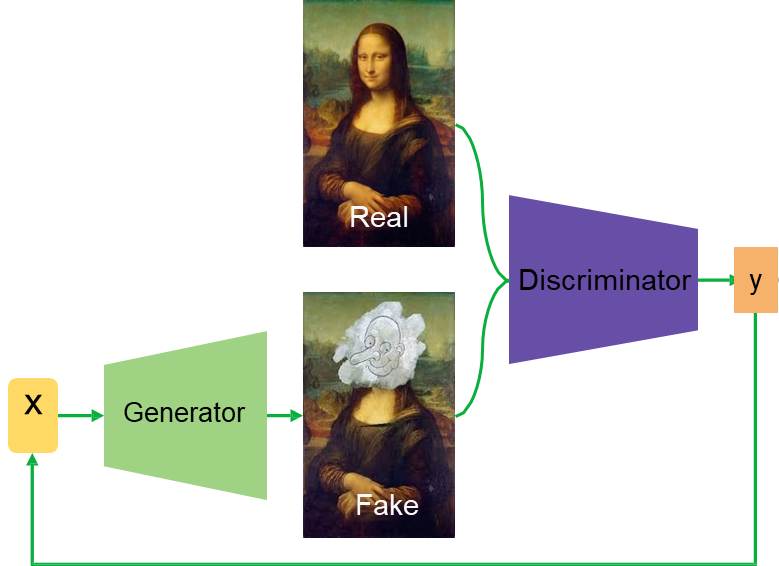
- Generative Adversarial Networks (GANs): GANs consist of two neural networks, a generator and a discriminator, that compete against each other to create highly realistic synthetic data. This technique is particularly effective for generating synthetic images, videos, and text.
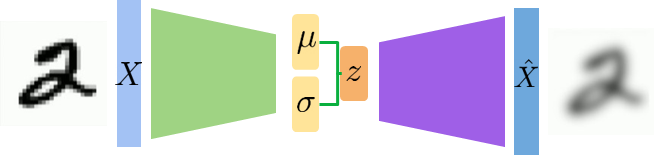
- Variational Autoencoders (VAEs): VAEs work by encoding real data into a lower-dimensional latent space and then decoding it back into synthetic samples. This method is useful for generating data that closely resembles the original dataset while introducing variations that enhance diversity.
Other methods include probabilistic modeling, rule-based synthesis, and agent-based simulations, each offering different levels of control and realism in data generation.
Applications of Synthetic Data
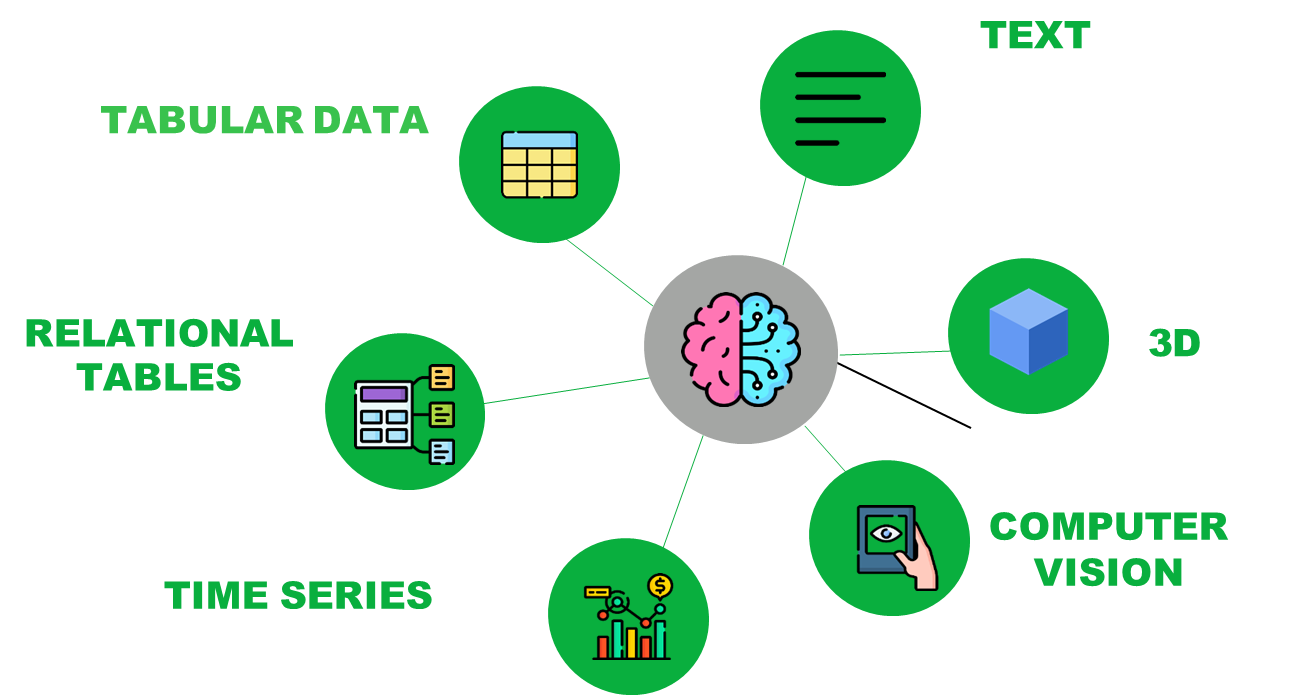
The versatility of synthetic data enables its use across a wide range of domains, including:
- Natural Language Processing (NLP): Generating diverse and high-quality text data for training language models, improving chatbot interactions, and enhancing speech recognition systems.
- Tabular Data: Creating structured datasets that reduce bias and improve the fairness of machine learning models in sectors such as finance, healthcare, and risk assessment.
- Relational Databases: Producing synthetic relational tables while preserving multi-table dependencies and constraints, ensuring realistic database simulations.
- 3D Modeling: Constructing synthetic 3D environments for training autonomous vehicles, robotics, and augmented reality applications.
- Time Series Forecasting: Combining multiple time series datasets to generate synthetic sequences that improve forecasting models in stock market analysis, weather prediction, and anomaly detection.
- Computer Vision: Producing synthetic images and augmenting datasets to enhance object recognition, facial recognition, and medical image analysis.
Multipurpose Synthetic Data Framework
Definition
A Multipurpose Synthetic Data Framework is a structured approach to generating and utilizing synthetic data for various applications, including data monetization, machine learning model training, and secure software development. This framework enables organizations to create high-quality synthetic datasets that preserve the statistical integrity of real-world data while ensuring privacy, scalability, and enhanced usability across different domains.
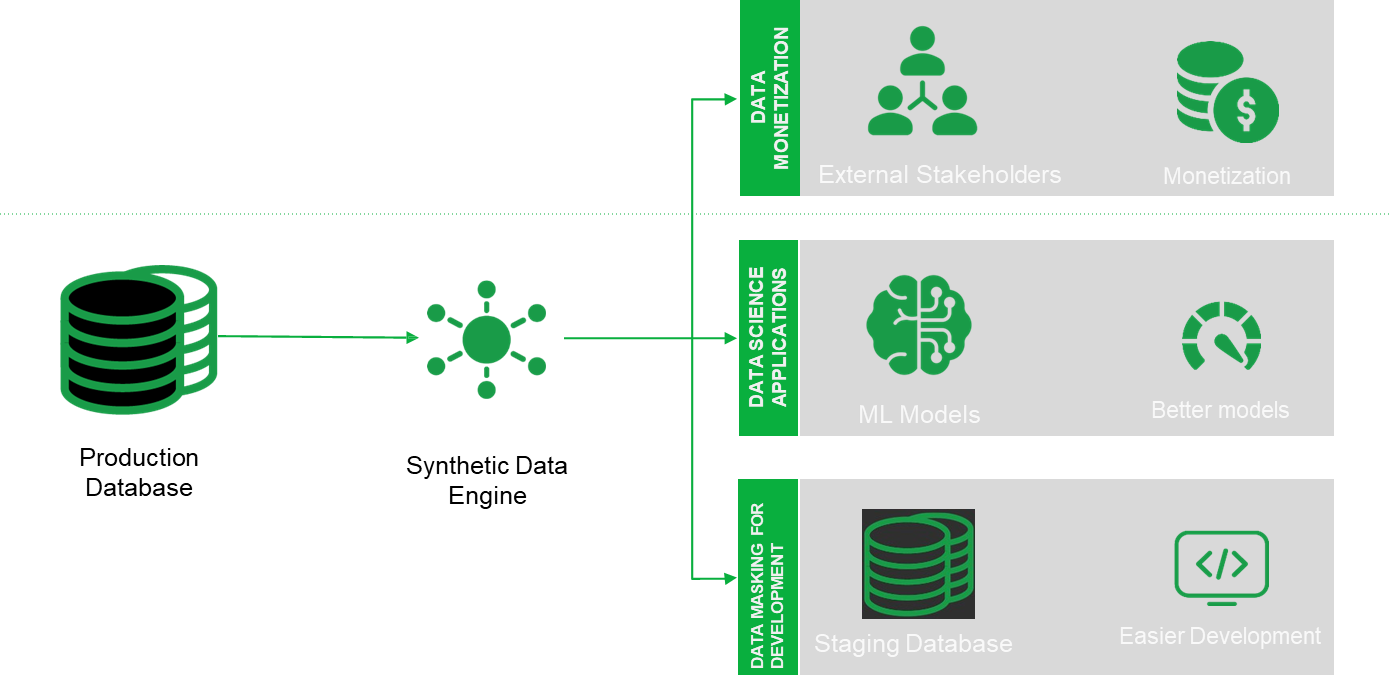
Data Monetization
Organizations that own large datasets often face challenges in sharing data due to privacy regulations, intellectual property concerns, and competitive restrictions. However, synthetic data enables data monetization by allowing businesses to generate and share artificial datasets that maintain the statistical properties of real data while eliminating personally identifiable information (PII).
Companies possess vast amounts of valuable data that could benefit third-party businesses. Many industries, such as finance and healthcare, require access to external datasets to improve their products and services. Privacy policies and compliance regulations, such as GDPR, restrict data sharing, making it difficult for organizations to leverage their data assets fully.
By synthesizing sensitive data, companies can create privacy-compliant datasets that retain the essential features of real data while protecting sensitive information. These datasets can be shared or sold to third parties without violating regulations. This approach allows businesses to overcome the barriers imposed by privacy concerns and compliance requirements. Companies of all sizes can leverage synthetic data to drive innovation and competition. Businesses can extract value from data that was previously restricted by privacy concerns, enabling enhanced data-driven decision-making across industries, including healthcare, finance, and marketing. This not only fosters innovation but also promotes a more competitive market landscape where data can be utilized to its full potential.
Data Science Applications
The synthetic data framework plays a crucial role in machine learning (ML) model development by generating artificial datasets for training and evaluation. These datasets help overcome common challenges such as data scarcity, imbalance, and privacy concerns.
The framework includes a synthetic data engine that produces diverse and high-quality samples, ensuring that models generalize well to real-world scenarios. Some notable applications in this domain include:
- Training autonomous vehicles by generating synthetic driving scenarios that replicate different weather conditions, road types, and pedestrian behaviors.
- Improving deep learning models by augmenting datasets with synthetic variations to enhance performance in image recognition, fraud detection, and anomaly detection tasks.
- Simulating rare or extreme events that might be underrepresented in real-world datasets, such as cybersecurity threats, medical anomalies, or financial crises.
Fraud Detection
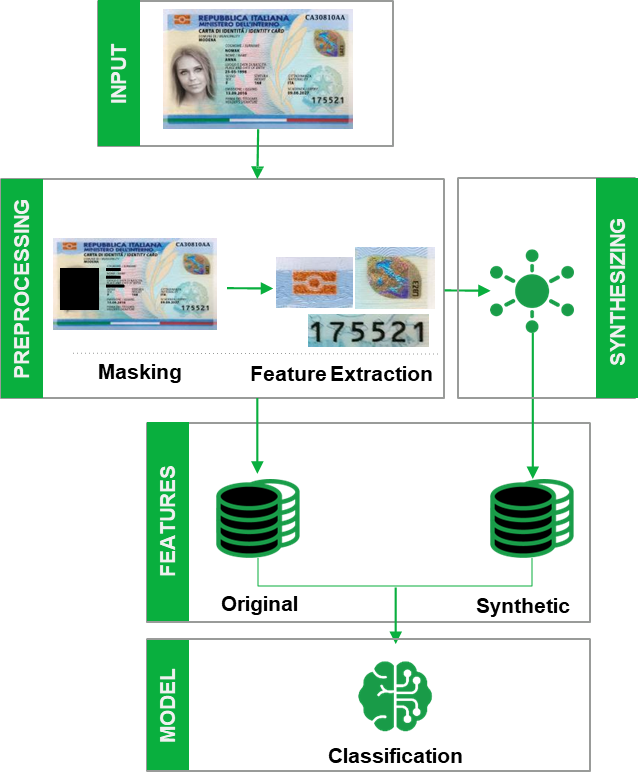
Detecting fraudulent activity, such as the use of fake identification documents for financial fraud, is a complex task that requires large-scale training datasets. However, acquiring real fraudulent documents is difficult due to their sensitive nature. Synthetic data can be used to augment fraud detection models by generating realistic counterfeit IDs for training machine learning algorithms.
Fraud detection relies on highly sensitive personal data, which limits access for research and model development. Obtaining real examples of counterfeit documents is difficult, and the process involves analyzing complex visual and textual data. By synthesizing document features, synthetic data allows for data augmentation, balancing datasets between real and fake documents. This ensures that machine learning models are not biased toward legitimate documents and can effectively identify fraudulent ones.
The business impact of using synthetic data in fraud detection is significant. It automates the detection of fake IDs, reducing reliance on manual review. This approach is also privacy-friendly, as it removes real customer data from training models, ensuring compliance with data protection regulations.
Data Masking for Software Development
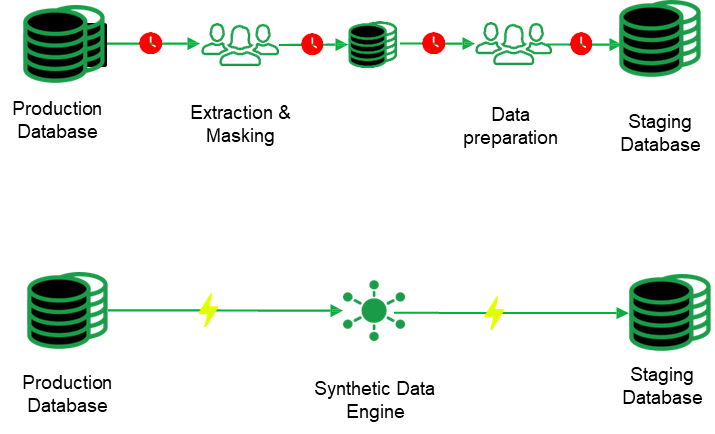
Developers and testers often need real-world data to ensure that applications function correctly. However, using sensitive production data in development environments poses privacy and security risks. Synthetic data offers a solution by generating artificial but realistic datasets that replicate production data characteristics.
One of the main challenges is that sensitive data cannot be used in non-production environments due to stringent security policies. This restriction often leads to the use of randomized or masked data, which typically lacks representativeness and results in poor test coverage. Additionally, traditional anonymization methods may still expose patterns that can be exploited, further compromising data security.
To address these issues, a synthetic data model can be trained on production information to generate realistic but anonymized datasets for testing and development purposes. This approach allows for large-scale data replication without exposing actual customer data, thereby maintaining privacy and security.
The business impact of using synthetic data in development is significant. It enables the creation of reproducible scenarios for software testing, ensuring that applications are thoroughly vetted before deployment. Moreover, synthetic data provides greater flexibility in customizing datasets to meet specific development needs, enhancing the overall efficiency and effectiveness of the testing process.
Challenges of Synthetic Data
While synthetic data offers numerous benefits, its implementation is not without challenges.
-
Representativeness One of the most critical challenges in synthetic data generation is ensuring that the artificial data accurately reflects the statistical properties and patterns of real-world data. If the synthetic dataset does not capture the complexity and diversity of the original dataset, models trained on it may not generalize well to real-world scenarios.
-
Validation It is essential to validate whether models trained on synthetic data can effectively perform in real-world applications. This requires rigorous testing and benchmarking against real datasets to confirm that synthetic data truly preserves the underlying structure of the original data.
-
Bias and Fairness Biases present in real-world data can be inadvertently transferred to synthetic data if not handled correctly. Moreover, the synthetic data generation process itself may introduce biases, leading to unfair or skewed model outcomes. Developers must carefully design generation methods to ensure fairness and diversity in the dataset.
-
Transparency and Accountability Understanding how synthetic data is created, what methodologies are used, and how it differs from real data is crucial for maintaining trust in AI-driven applications. Clear documentation and explainability mechanisms should be in place to ensure that synthetic data is used ethically and responsibly.
The demand for synthetic data is rapidly increasing, driven by the need for privacy, speed, and high-quality data in machine learning and AI applications. Organizations are leveraging synthetic data to overcome real-world limitations, enable secure data sharing, and improve model performance.
According to Gartner,
by 2030, synthetic data will completely overshadow real data in AI models, marking a major shift in how data is generated, shared, and utilized.
However, careful consideration must be given to challenges such as data representativeness, validation, bias mitigation, and transparency to ensure that synthetic data truly enhances AI systems while maintaining ethical standards.